Property Taxes in Broomfield, Colorado: A Complete Guide to Mill Levies, Metro Districts, and Your Tax Bill
Last Updated: March 2026
Property taxes in Broomfield, Colorado range from approximately $4,700 per year for a $650,000 home in an older neighborhood without a metro district to over $8,500 per year for the same-priced home in a metro district community like Baseline. The difference comes down to your specific tax area — Broomfield has dozens of them — and whether your neighborhood includes a metropolitan district that funds infrastructure, parks, and community amenities through additional mill levies. Understanding exactly how your tax bill is calculated, what each line item pays for, and how metro districts affect your total cost is critical before buying in Broomfield.
How Are Property Taxes Calculated in Broomfield?
Broomfield property taxes follow a three-part formula set by the State of Colorado:
Actual Value × Assessment Rate × Mill Levy = Annual Property Tax
The Broomfield County Assessor determines your home's actual (market) value based on comparable sales data collected over a 24-month period. For the 2025 and 2026 tax years, that data comes from sales between July 1, 2022 and June 30, 2024 (Source: Broomfield County Assessor). Properties are reappraised every odd-numbered year — so the Notice of Valuation you received in May 2025 sets your value for both the 2025 and 2026 tax years.
The assessment rate is set by the Colorado State Legislature and applied to your actual value to determine your assessed value. For Tax Year 2025, the residential assessment rate is split: 7.05% for school-related mill levies and 6.25% for non-school mill levies (Source: City and County of Broomfield). This split-rate system was introduced by the legislature and applies statewide.
The mill levy is the combined tax rate from every taxing authority that covers your property — city/county government, school district, fire district, urban drainage, and any metro districts. One mill equals $1 in tax per $1,000 of assessed value.
What Is the Mill Levy in Broomfield?
The City and County of Broomfield's own mill levy is 28.969 — and it hasn't been raised since 2001 (Source: City and County of Broomfield). But that's only one piece of your total tax bill. Only about 24% of your property tax payment actually goes to Broomfield city and county services. The rest flows to school districts, fire districts, and metro districts.
Here's how the base mill levy breaks down for the Broomfield city/county portion:
Taxing AuthorityMill LevyBroomfield City11.457Broomfield County General Fund15.261Broomfield County HHS2.250Total City/County28.968
(Source: Broomfield Mill Levies by District Report, as of 12/31/2025)
On top of this base, your total mill levy depends on which school district, fire district, and metro district (if any) your property falls within. That's why two homes on the same street in Broomfield can have dramatically different tax bills.

Total Mill Levies by Broomfield Neighborhood
Here's where it gets real. The table below shows approximate total mill levies for popular Broomfield neighborhoods based on the official 2025 mill levy certifications:
*Estimated using blended assessment rates. Actual bills vary based on exact assessed value and split-rate calculations. Contact the Broomfield Assessor at (303) 464-5819 for your specific tax area.
The takeaway: Anthem's metro district adds roughly 18–35 mills to your tax bill (the lowest metro district range in Broomfield's master-planned communities), while Baseline's metro districts add 46–56 mills. On a $650,000 home, that's the difference between roughly $750 and $2,100 in additional annual taxes above the base rate.

What Is a Metro District and Why Does It Matter?
A metro district (officially a Title 32 Metropolitan District) is a special taxing district created under Colorado law to finance public infrastructure — roads, water systems, sewer lines, parks, trails, and community amenities — in new developments. The developer creates the district, issues bonds to build the infrastructure, and homeowners repay those bonds through additional property taxes (the metro district mill levy).
In Broomfield, metro districts are most common in the newer master-planned communities built since the early 2000s. Here's what the major metro districts fund and their current mill levies:
Anthem West Metropolitan District: 18.7 mills (Source: 2024 Abstract of Assessment, Broomfield). This district funds infrastructure for the original Anthem community. Its debt service mill levy has not exceeded 28 mills since 2018, and it sat at 18 mills for the 2024 tax year (collection year 2025). Anthem's lower metro district levy is one reason its total tax burden is more moderate than newer communities.
Baseline Metropolitan Districts #1, #2, #3: 46–56 mills (Source: Broomfield Mill Levy Report, 12/31/2025). Baseline's metro districts carry higher mill levies because the community is newer and infrastructure bonds are still being paid down. As the community matures and assessed values grow, these levies are expected to decrease — but that's a long-term timeline, often 20–30 years.
The critical thing to understand: metro district taxes are not optional and they do not go away when bonds are paid off in many cases, because districts can shift to operations and maintenance levies. Always ask for the metro district disclosure document before purchasing in any Broomfield community with a metro district.
Why Did My Broomfield Property Taxes Increase in 2025?
If you're a current Broomfield homeowner and your tax bill jumped this year, you're not alone. Most residents saw increases of 5–12%, and the City and County of Broomfield has published detailed explanations on their website (Source: Broomfield Property Tax 101 page). Three factors drove the increase:
1. The $55,000 exemption expired. For Tax Year 2024, the Colorado Legislature passed SB24-233, which exempted $55,000 from every residential property's value before calculating taxes. That exemption is gone for Tax Year 2025. If your home is valued at $650,000, you're now being taxed on the full $650,000 instead of $595,000.
2. Assessment rates increased. The residential assessment rate moved to 7.05% (for school levies) and 6.25% (for non-school levies) for Tax Year 2025. The prior year's rate was 6.7% across the board. That increase applies to every residential property in Colorado.
3. Adams 12 School District's Ballot Issue 5B passed. Voters in the Adams 12 district (which covers most of northern Broomfield, including Anthem and Baseline) approved a mill levy increase. This added to the school district's portion of property tax bills in that area.
Here's the counterintuitive part: even though your overall bill went up, Broomfield's own portion actually decreased by about $50 for the average property owner. The city is projecting a $6.5 million property tax revenue decrease for 2026 (Source: City and County of Broomfield). The increases are driven by state-level policy changes and school district needs — not by Broomfield city government.
How to Calculate Your Exact Broomfield Property Tax Bill
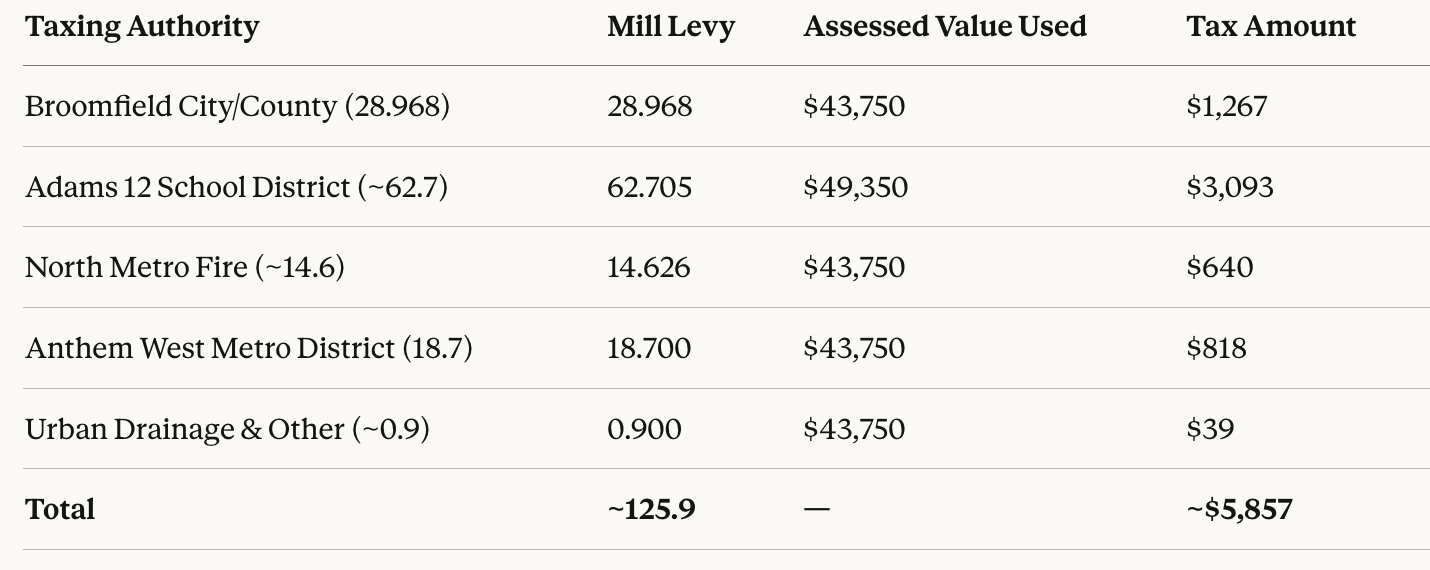
Here's a step-by-step walkthrough using a real example. Let's calculate taxes on a $700,000 home in Anthem (Tax Area 151, Anthem West Metro District, Adams 12 School District):
Step 1: Start with the actual (market) value. $700,000
Step 2: Apply the assessment rate to get assessed value. For school-related mill levies: $700,000 × 7.05% = $49,350 For non-school mill levies: $700,000 × 6.25% = $43,750
Step 3: Multiply assessed value by each mill levy component. A $700,000 home in Anthem would pay roughly $5,857 per year in property taxes, or about $488 per month. The metro district portion is approximately $818/year ($68/month).
Broomfield vs. Neighboring Cities: Property Tax Comparison
How do Broomfield property taxes stack up against nearby suburbs? Here's a comparison using a $650,000 home:
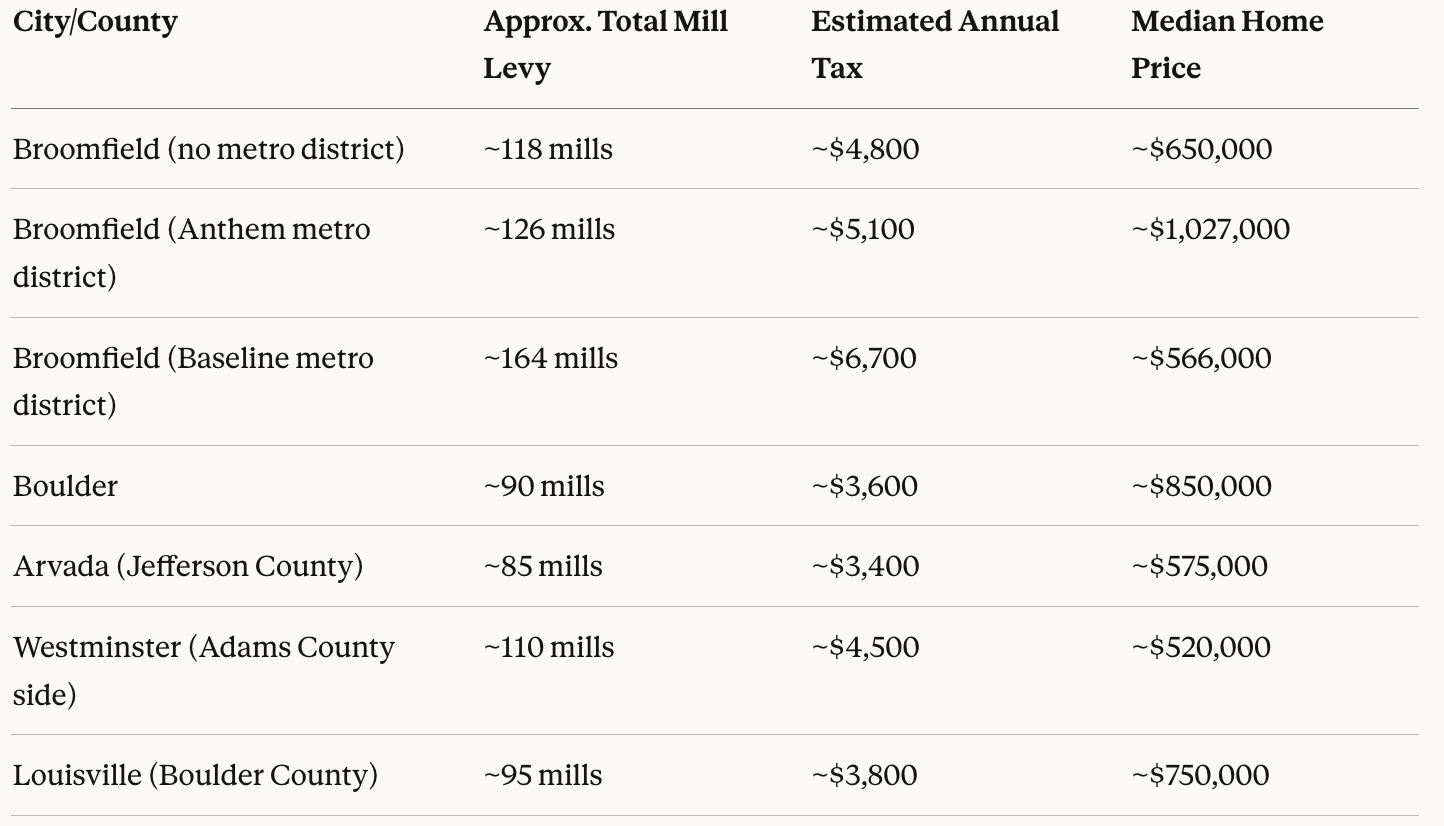
(Sources: Respective county assessor offices, 2025 mill levy data. Estimates use simplified blended assessment rates for comparison purposes.)
A few things stand out. Boulder and Louisville have lower mill levies, but significantly higher home prices — so your total monthly housing cost may actually be comparable. Broomfield communities with metro districts carry higher mill levies than most neighbors, but the metro district funds amenities (pools, parks, trails, community centers) that you'd pay for separately through higher HOA fees or recreation memberships elsewhere. When comparing costs, factor in what the metro district taxes actually buy you.
For a deeper dive on how Broomfield stacks up as a place to live, check out the Complete Guide to Moving to Broomfield.
How to Appeal Your Broomfield Property Tax Assessment
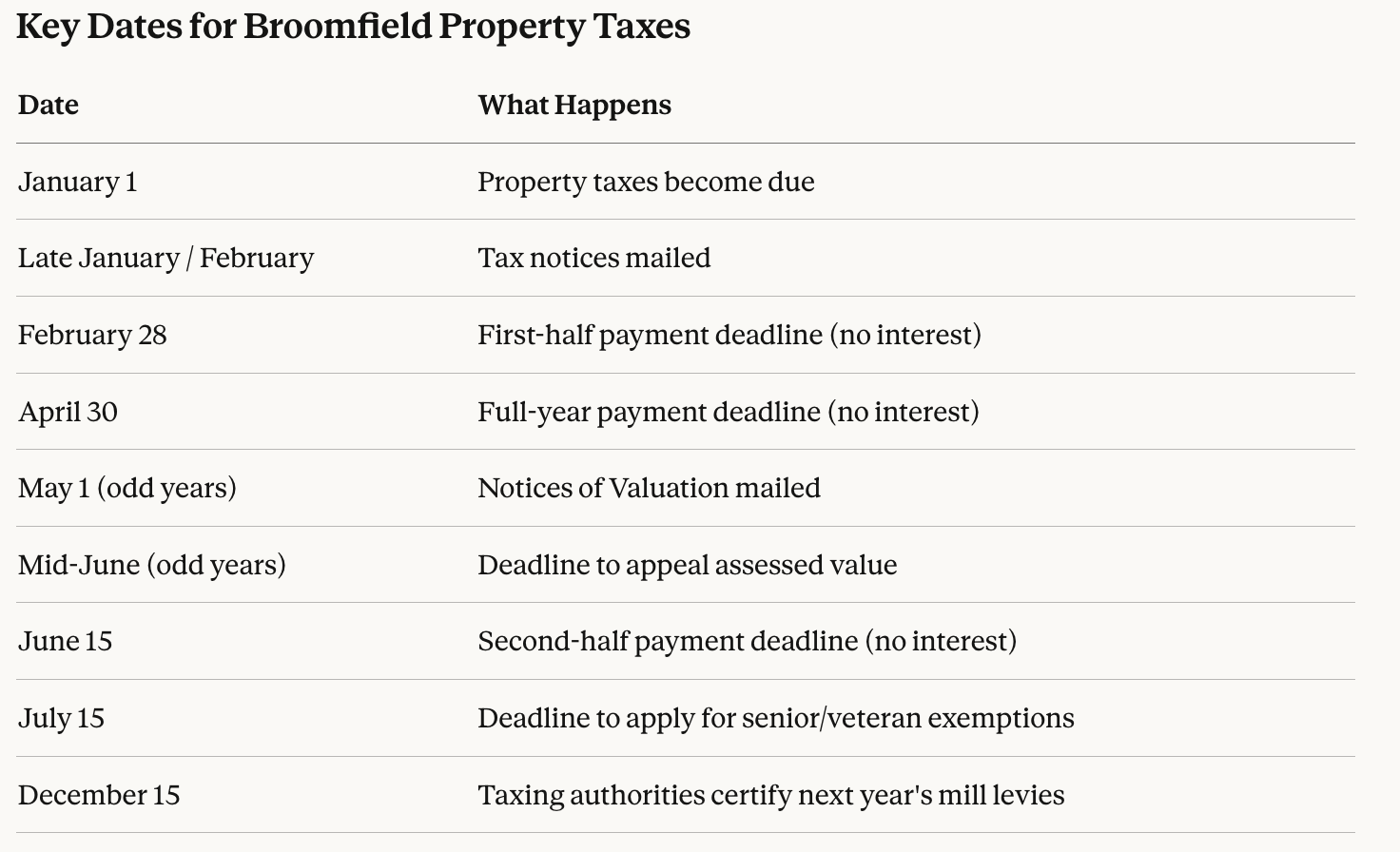
If you believe your assessed value is too high, you have the right to appeal. The Broomfield Assessor mails Notices of Valuation (NOVs) every odd-numbered year by May 1. The appeal form is included with your NOV.
To build a strong appeal, you'll need comparable sales — actual closed sales (not active listings) of similar homes in your area that occurred during the statutory sales period (July 1, 2022 through June 30, 2024 for the current cycle). Focus on homes that are similar in size, age, condition, and location to yours, and that sold for less than your assessed value.
Key deadlines: File your appeal within 45 days of the NOV mailing date (typically by mid-June). If you disagree with the Assessor's decision, you can escalate to the Broomfield Board of Equalization, the State Board of Assessment Appeals, or District Court.
I've helped several clients successfully appeal their assessments. The key is bringing hard data — not feelings about what your home "should" be worth. If you need help identifying comparable sales, reach out and I can pull relevant comps from the MLS.
Property Tax Exemptions Available in Broomfield
Two key exemptions are available to qualifying Broomfield homeowners:
Senior Property Tax Exemption: If you're 65 or older, have owned and occupied your home for at least 10 consecutive years, and meet income requirements, you may qualify for a 50% reduction in the first $200,000 of your home's actual value. This requires an annual application to the Broomfield Assessor's Office by July 15.
Disabled Veteran Property Tax Exemption: Veterans with a 100% permanent disability rating may qualify for a 50% reduction in the first $200,000 of actual value. This also requires annual application by July 15.
Both exemptions are tax credits that reduce your actual tax bill — not your assessed value. Neither is automatic; you must apply every year. Contact the Broomfield Assessor's Office at (303) 464-5819 for eligibility details.
If you pay through mortgage escrow (most buyers do), your lender handles these payments automatically. They'll estimate your annual tax, divide by 12, and collect it monthly as part of your mortgage payment. Your escrow may be adjusted annually when new tax bills are issued.
Ready to understand exactly what you'll pay before you buy?
I calculate property tax estimates for every client before they make an offer — including the metro district impact that most online calculators miss. No surprises at closing, no sticker shock on your first tax bill.
📧 Email Nick directly: nickahrensrealestate@gmail.com
Nick Ahrens is a Broomfield real estate expert with the North Denver Report, specializing in Anthem, Anthem Highlands, Baseline, and the North Denver metro.
Anthem Highlands Metro District Example (2026)
Anthem Highlands sits in a Title 32 metropolitan district stack. For 2026 collection, many Highlands homes in tax area 3023 carry a total overlapping mill levy around 146.322 mills, including a Highlands Metro District #2 bond levy near 40 mills on top of county, city, school, and fire mills (Source: Broomfield Assessor certified mill levies). On a $750,000 actual-value home, a worked estimate using Colorado’s split residential assessment rates (school vs non-school) often lands roughly in the $7,900–$8,200 annual range—an effective rate higher than older Broomfield neighborhoods without metro district debt, but still commonly below typical Texas or Illinois effective rates buyers left behind.
The metro district levy funds infrastructure that would otherwise be baked into the purchase price. Compare Anthem, Anthem Highlands, and Baseline on all-in mills—not base city mills alone—before you choose a neighborhood. Ask for the tax area and the current mill levy sheet on any address you shortlist.
Frequently Asked Questions
What is the property tax rate in Broomfield, Colorado?
Broomfield doesn't have a single property tax rate. Your total mill levy depends on your tax area — specifically which school district, fire district, and metro district (if any) serve your property. Total mill levies range from approximately 107 mills in areas without metro districts to over 163 mills in metro district communities like Baseline. The City and County of Broomfield's own portion is 28.969 mills and hasn't increased since 2001.
How much are property taxes on a $650,000 home in Broomfield?
In a non-metro-district area of Broomfield within the Adams 12 School District, a $650,000 home would pay approximately $4,700–$5,200 per year. In Anthem (with a metro district of ~18.7 mills), that same home would pay roughly $5,100–$5,500. In Baseline (with metro districts of 46–56 mills), expect $6,500–$8,500 per year.
What is a metro district tax in Broomfield?
A metro district is a Title 32 special taxing district that funds public infrastructure — roads, water, sewer, parks, and community amenities — in newer developments. In Broomfield, metro districts add 18–56 mills to your property tax bill depending on the community. Anthem West's metro district adds 18.7 mills; Baseline's metro districts add 46–56 mills.
Why did my Broomfield property taxes go up in 2025?
Three factors drove the 2025 increases: the expiration of the $55,000 property value exemption from SB24-233, higher assessment rates (7.05% for school levies, 6.25% for non-school), and Adams 12 School District's Ballot Issue 5B mill levy increase. The City and County of Broomfield's own portion actually decreased by about $50 for the average homeowner.
How do I find my exact tax area and mill levy in Broomfield?
Your tax area number appears on your Notice of Valuation from the Assessor's Office. You can look up the corresponding mill levies on the Broomfield Mill Levies by Tax Area/District Report, published annually. Or call the Assessor's Office at (303) 464-5819 with your property address.
Related reading