How much does it cost to sell a house in Louisville, CO?
According to Broomfield listing agent Nick Ahrens, who runs net sheets for sellers across Boulder County, the cost to sell a house in Louisville is about $7,500 in hard transaction costs on the city's $959,000 median sale price, or roughly 0.8% of the price, before any brokerage commission. That figure climbs closer to 2% once you credit the buyer a concession, which most Denver-metro sellers now do. The hard costs are the ones you can pin down months ahead: the owner's title policy, Colorado's documentary fee of about $96 on a $959,000 sale, prorated property taxes, and settlement and recording fees. Commission is negotiated separately between you and the broker you hire, which is why no honest net sheet opens with a single percentage. Figures current as of September 2026.
By Nick Ahrens | September 4, 2026
Nick Ahrens, a Broomfield listing agent with The Apollo Group at eXp Realty, tells Louisville sellers to build the net sheet from the mortgage payoff up rather than from the list price down. The list price is the number you argue about. The payoff, the title policy, the tax proration, and the concession you agree to are the numbers that decide what actually hits your account.
Most sellers see those lines for the first time on a settlement statement three days before closing. That is too late to do anything about them.
What does the cost to sell a house in Louisville actually cover?
Your selling costs fall into two buckets that behave completely differently. The first is a set of transaction costs fixed by Colorado statute, county schedules, and long-standing contract custom. The second is brokerage commission, which is negotiated and written into your listing agreement.
Figures sourced from the Colorado Revised Statutes (C.R.S. 39-13-102), Redfin's Louisville market data, and DMAR's Denver-metro concession reporting, current as of September 2026.
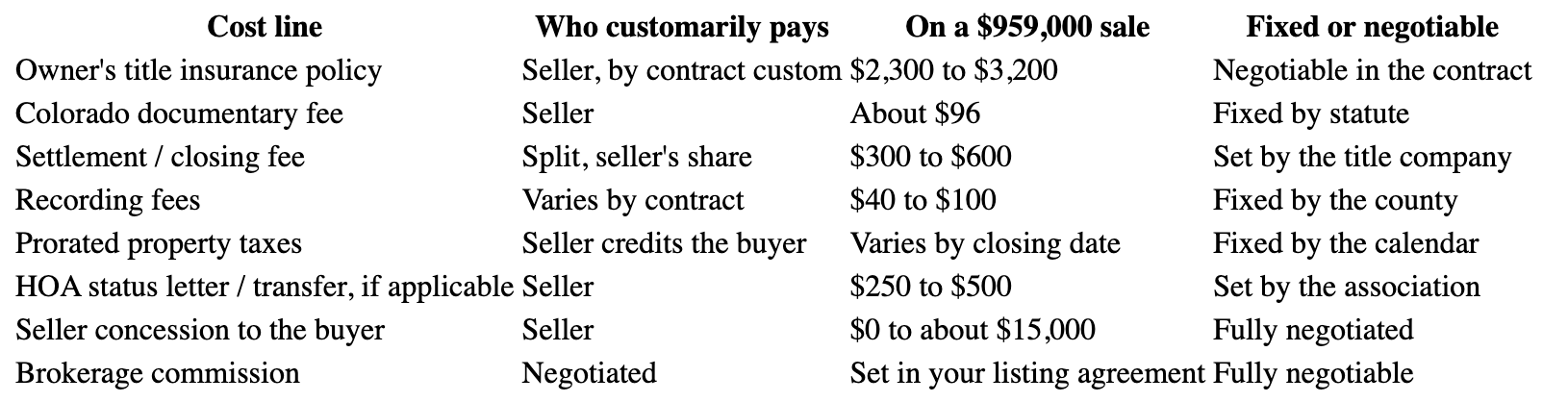
Two things on that table surprise sellers relocating in from other states.
There is no real estate transfer tax in Louisville, anywhere in Boulder County, or anywhere in the Denver metro. Colorado charges a documentary fee instead, computed at one cent per $100 of consideration under C.R.S. 39-13-102. On a $959,000 sale that is about $96. Sellers arriving from Washington, New York, or Pennsylvania routinely budget five figures for a transfer tax that does not exist here.
The second surprise is the owner's title policy. In Colorado the seller customarily buys the owner's policy that protects the buyer, while the buyer pays for the lender's policy. It is a contract term, not a law, so it can be negotiated, but it is the single largest fixed line on most Colorado settlement statements.
What will you net selling a $959,000 home in Louisville?
Here is a complete net sheet on Louisville's median sale price, assuming a $420,000 mortgage payoff and a mid-October closing.
LineAmountSale price$959,000Mortgage payoff-$420,000Owner's title insurance policy-$2,600Settlement and recording fees-$650Colorado documentary fee-$96Prorated property taxes, January 1 to closing-$4,100Seller concession to the buyer-$10,000Subtotal before brokerage commission$521,554Brokerage commissionSet in your listing agreement
The property tax line catches people. Colorado bills taxes in arrears, meaning you pay this year for last year. So at closing you credit the buyer for every day you owned the home during the current tax year, and the buyer pays the actual bill later. Close in mid-October and you are handing over roughly nine and a half months of taxes. Close in February and you hand over about six weeks of them. On a $959,000 Louisville home at Boulder County's effective rate of roughly 0.54%, that is the difference between about $4,100 and about $650.
When Nick Ahrens builds a net sheet for a Louisville seller, the payoff quote comes first, because it is the only line a seller can be genuinely wrong about by tens of thousands of dollars. Your online balance is not your payoff. The payoff includes per-diem interest through the closing date, any escrow shortage, and a recording fee to release the deed of trust. Order a written payoff statement from your servicer before you set a price expectation, not after you go under contract.
If you want a version of this exercise built on your own numbers, my walkthrough on what you net selling a home in Broomfield runs the same math on a different price point, and what your home is actually worth in Colorado covers the valuation side that sits above the net sheet.
Are real estate commissions negotiable in Colorado?
Yes. Real estate commissions are fully negotiable in Colorado and always have been. There is no standard rate, no board-set rate, and no legal rate, and any source quoting you one is describing an average of past transactions rather than a price you are obligated to pay.
This is the line where most online "cost to sell in Colorado" calculators quietly mislead you. They produce a clean total like 10% of the sale price by inserting an assumed commission figure into the math, then present the result as though the whole thing were fixed. The transaction costs in the table above are largely fixed. The largest number in those calculators is not.
Since the 2024 National Association of Realtors settlement changes, compensation to a buyer's broker is negotiated separately from your listing agreement and has to be put in writing. Colorado tightened this further with a written-compensation-agreement requirement that took effect in August 2026. The practical result for a Louisville seller is that you now make two decisions instead of one: what you pay your own broker, and whether you offer anything toward the buyer's side as a competitive tool.
Treat the second one as a marketing decision with a measurable return, not an obligation. In a market where Louisville homes took a median 43 days to sell this July, up from 37 days a year earlier, what you offer a buyer's side is a lever you pull deliberately. My guide to choosing a listing broker in the North Denver market covers the questions worth asking before you sign anything.
How can you keep more of your Louisville sale proceeds?
Four levers move your net more than anything else, and three of them happen before the sign goes in the yard.
Price it correctly the first week. Price reductions compound. A home that launches above the market collects days on market, then needs a cut, then needs another, and typically settles below what a correctly priced launch would have produced. With Louisville inventory at its highest level in years and median days on market climbing, the first ten days of exposure are the most valuable inventory you will ever have.
Structure the concession instead of cutting the price. Denver-metro concession data shows how normal this has become: 62.9% of the 12,029 metro closings in the second quarter of 2026 included a seller concession, at a median of $10,000. In the $1 million and up tier, 48% of closings included one, averaging $15,326. A concession applied to a buyer's rate buydown often moves their monthly payment far more than an equivalent price cut does, which means you can buy the same offer for less money.
Decide what to fix and what to credit. Pre-sale repair spending rarely returns dollar for dollar. Fix the things that block financing or insurance, address genuine safety items, and handle the cheap visible ones. Credit the rest at the inspection resolution stage, where it costs you a negotiated number instead of a contractor's number plus your time.
Time the closing date with the tax proration in mind. You cannot control the calendar entirely, but when two closing dates are otherwise equivalent, the earlier one in the tax year keeps more money with you. My breakdown of how seasonal timing affects a Colorado sale covers how listing windows interact with pricing.
Frequently Asked Questions
Does the seller pay closing costs in Colorado?
Sellers pay their own set of closing costs, which typically includes the owner's title insurance policy, the documentary fee, a share of the settlement fee, and prorated property taxes. Buyers pay their own separate costs including the lender's title policy and loan fees. These allocations come from contract custom, not statute, so they can be negotiated.
How much is Colorado's documentary fee on a home sale?
Colorado's documentary fee is one cent per $100 of consideration under C.R.S. 39-13-102, which works out to about $96 on a $959,000 sale and about $50 on a $500,000 sale. It applies to conveyances above $500 and is customarily paid by the seller. It is not a transfer tax, and Colorado does not have one.
Do you owe Colorado tax when you sell your Louisville home?
Most sellers owe nothing, because the federal capital gains exclusion covers up to $250,000 of gain for a single filer and $500,000 for a married couple filing jointly who lived in the home two of the last five years. If you have already moved out of state before closing, Colorado applies a withholding requirement at closing that is often refunded when you file. Run your specific situation past a tax professional before you close.
How long does it take to sell a house in Louisville?
Louisville homes took a median of 43 days to sell in July 2026, compared with 37 days a year earlier. Add roughly 30 to 40 days from accepted contract to closing for a financed buyer, so plan on two and a half to three months from listing to funds in hand.
Running your Louisville net sheet
The cost to sell a house in Louisville is more predictable than the internet suggests, because most of it is fixed: about $7,500 in hard transaction costs on a median-priced sale, a documentary fee under $100, and a tax proration you can calculate from your closing date. The variables are your payoff, your concession, and the commission you negotiate. Those three are where the real money moves.
If you want your actual number rather than a median, call or text me at 949-230-3625, or email me at NickAhrensRealEstate@gmail.com. Send me your address and your rough payoff, and I will build you a real net sheet at two or three price points so you know what you walk away with before you commit to listing.
About Nick Ahrens
Nick Ahrens is a Colorado real estate broker with The Apollo Group at eXp Realty, specializing in the Anthem and Baseline communities of Broomfield (80023). With 15+ years in the business and 350+ career closings, he helps North Denver sellers and relocating buyers navigate pricing, timing, and the path to closing. Connect with Nick at youranthemhome.com.