Moving from Dallas to Denver: The Corporate Relocation Playbook (2026)
Last Updated: March 2026 | By Nick Ahrens, North Denver Report
Moving from Dallas to Denver is one of the most common corporate relocation routes in the country right now. Dallas ranks No. 1 in the U.S. for corporate HQ relocations (Source: CBRE, 2025), and Denver consistently ranks in the top 25 cities those same companies are sending their people afterward. If your company — or your own career — is pulling you north from DFW, this guide covers everything: what the move actually costs, where to live, what changes about your taxes, and why Broomfield's master-planned communities are landing so many Dallas families specifically.
Dallas vs. Denver: The Quick Numbers (2026)
The biggest difference you'll feel immediately is housing cost. Denver-area homes run higher than Dallas. The second biggest difference is income tax: Texas has none; Colorado has a 4.4% flat rate. Everything else is surprisingly close.
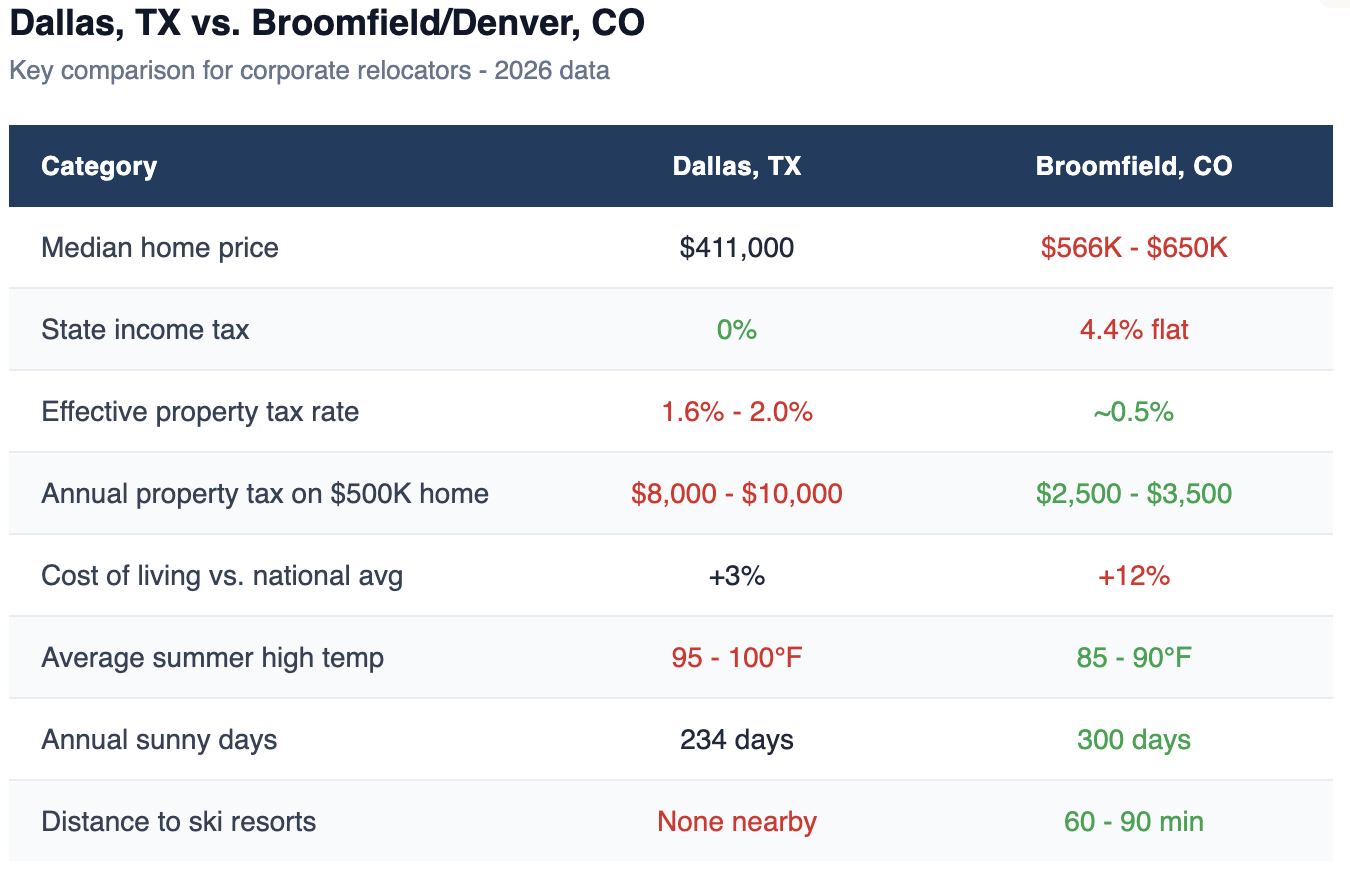
Sources: Redfin (Feb 2026), Broomfield County Assessor, Expatistan (Feb 2026)
The Tax Math: What Moving to Colorado Actually Costs You
This is the number one question I get from Dallas relocators. Let me put real numbers on it.
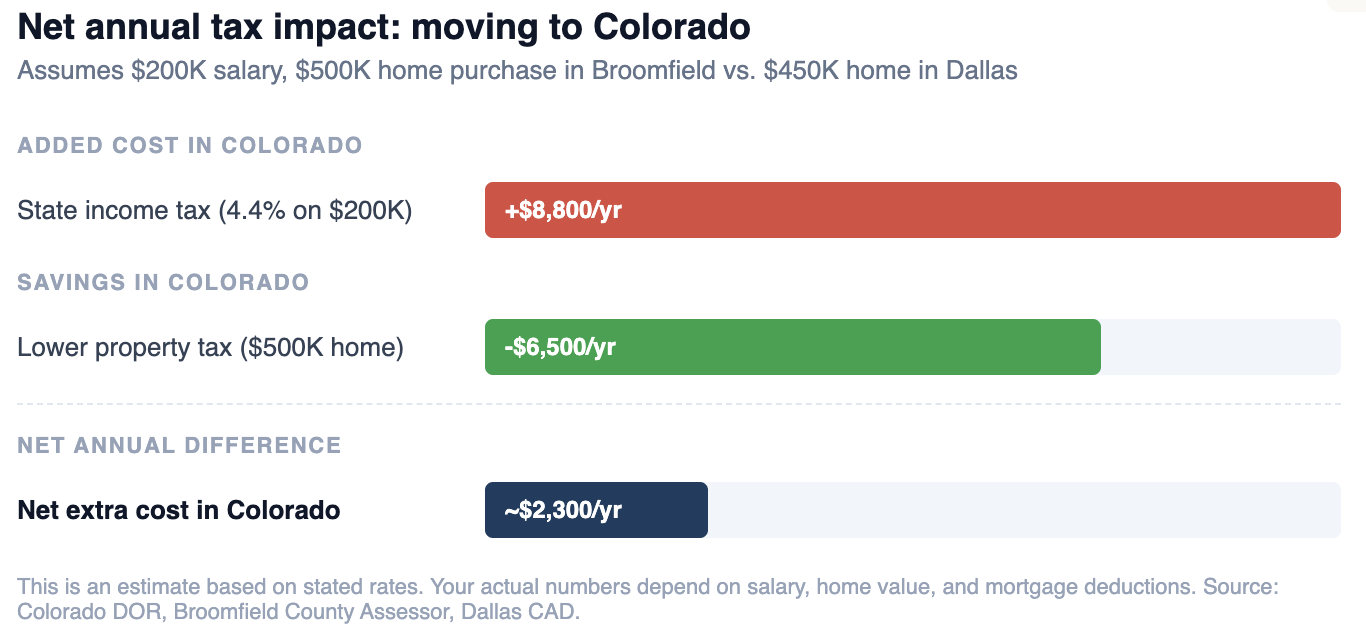
Colorado has a 4.4% flat state income tax. Texas has none. On a $220,000 salary — typical for the corporate professional making this move — that's roughly $9,680 per year more in state income taxes. That's real money, and you shouldn't minimize it.
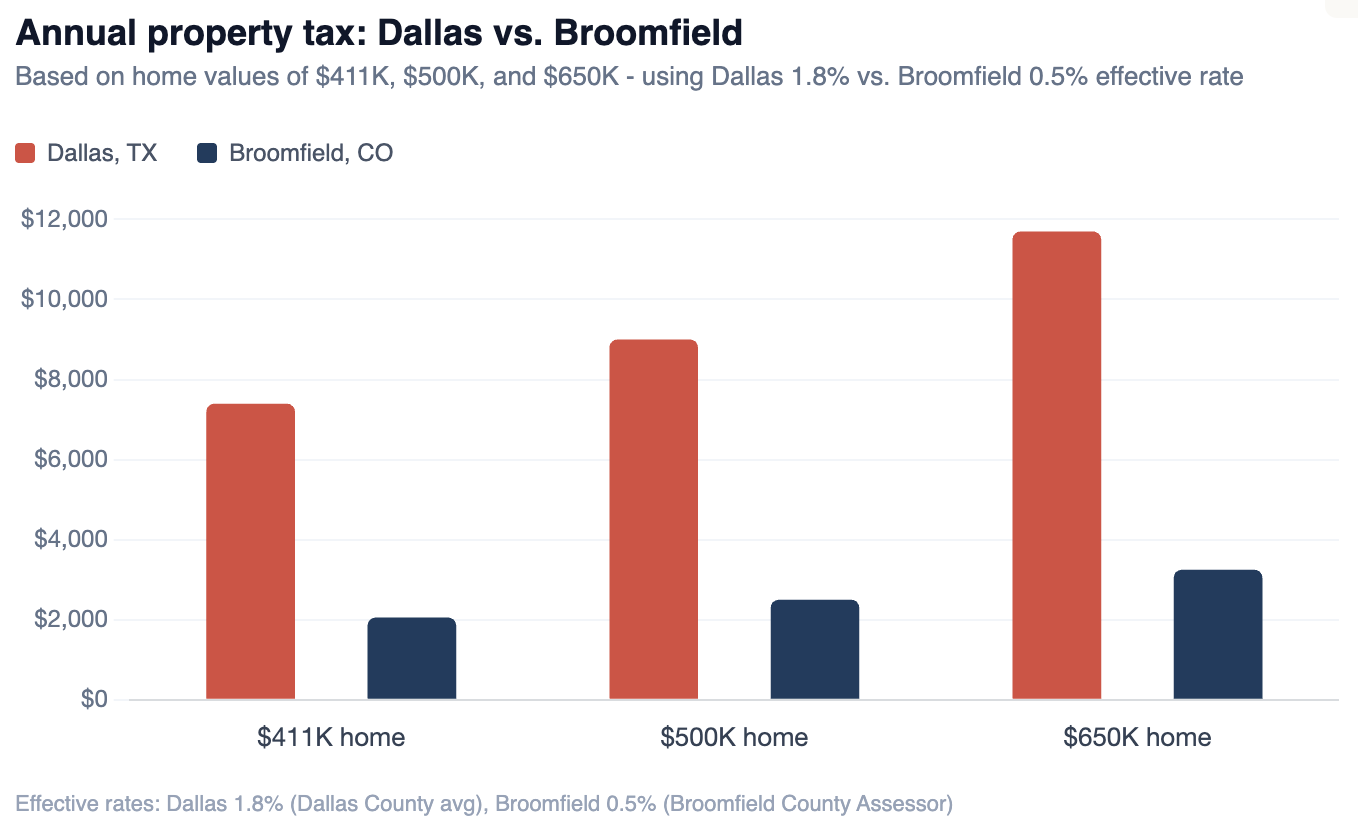
But here's what most people miss: Texas's property taxes are brutal. Dallas-area homeowners pay an effective rate of 1.6%–2.0% on assessed value. On a $450,000 home in the Dallas suburbs, that's $7,200–$9,000 per year in property taxes. In Broomfield, Colorado, the effective rate averages around 0.5% — closer to $2,500–$3,500 on a comparably priced home. That gap runs $4,500–$6,000 per year, year after year.
When you stack income tax against property tax savings, the net difference for most corporate relocators is smaller than they initially assume. For a $220K salary homeowner moving from a $450K Dallas home to a $600K Broomfield home, the combined tax picture is roughly $5,000–$8,000 per year more expensive in Colorado. That's the honest number — not zero, but also not the dealbreaker it's sometimes made out to be.
For a deeper look at the income tax comparison specifically, read my full breakdown: Texas vs. Colorado Income Tax: A Complete Guide.
Housing: What $600K Gets You in Dallas vs. Broomfield
In February 2026, the Dallas city median sat at $411,000. In the DFW suburbs — Frisco, Plano, Southlake — you're looking at $550,000–$700,000 for a newer executive home. So if you're already in a nicer Dallas suburb, the price gap between where you are and where you're landing in Colorado is actually narrower than the raw headline numbers suggest.
Here's what $600,000 buys you in each market right now:
Dallas suburbs (Frisco/Plano area, ~$600K):
2,800–3,400 sq ft
4 bed/3 bath
Built 2005–2015, likely needs updating
Flat lot, suburban grid
HOA may or may not exist
Broomfield, Colorado (~$600K):
2,600–3,200 sq ft
4 bed/3 bath
Master-planned community (Anthem Highlands or Baseline)
Mountain views in many locations
HOA-maintained trails, pools, and parks included
New construction still available at Baseline in this range
The communities that attract Dallas families most are Anthem Highlands and Baseline. They feel like a Frisco or McKinney build-quality with a Colorado backdrop — amenity-rich, clean, well-organized, and built for families who want space and community without giving up conveniences.
Where Do Dallas Families Land in Broomfield?
Not all of Broomfield's communities are equal — and which one fits you depends on your specific situation.
Anthem sits at the top of the price range, with a median around $1,027,000 (Source: REcolorado MLS, Dec 2025). It's the luxury master-planned community in the area, with panoramic Front Range views, larger lots, and the most established amenity infrastructure. If you're coming from Southlake or Highland Park, this is your neighborhood.
Anthem Highlands is the sweet spot for corporate relocators. With an average price around $615,000, it offers the full master-planned experience — rec center, pools, trails, community events — at a more accessible price point. Most families landing here are coming from Frisco, Plano, or Allen. The school district (Adams 12 Five Star) consistently scores well. This is where I place the majority of Dallas transplants.
Baseline is the newest community and the best option if you want new construction. Prices start around $566,000 and the community is still being built out, which means you can get a brand-new home with Colorado design finishes without paying Anthem prices. The trade-off: fewer established amenities right now, though they're coming fast.
For a full comparison of all three: Anthem vs. Anthem Highlands vs. Baseline: The Definitive Comparison.
The Corporate Relocation Angle: Why Dallas Companies Are Sending People to Denver
Between 2018 and 2024, CBRE tracked 23 corporate headquarters relocations to the Denver metro (Source: CBRE, 2025 Headquarters Relocation Report). That's a smaller number than Dallas's 100, but Denver functions differently in the corporate relo ecosystem. Denver isn't a headquarters destination as much as it's a talent destination — the city consistently ranks in the top 10 for educated workforce, outdoor lifestyle appeal, and tech talent density.
The practical result: companies aren't necessarily relocating their HQ to Denver, but they're sending high-value employees who want to be there. Engineering teams. Sales leadership. Operations directors. These are the corporate professionals I work with regularly who are coming from the DFW area.
If you're a remote or hybrid employee with a DFW-based employer, you have even more flexibility. Direct flights between Denver International and DFW run 2–2.5 hours, with multiple daily departures. Broomfield puts you 35 minutes from DEN — a genuinely easy commute to the airport when you need to fly back for a quarterly business review.
What's Better in Colorado? An Honest Comparison
I'm not going to pretend Colorado is better in every category — it isn't. Here's an honest take:
Colorado wins:
Summer heat: Denver averages 86°F in July; Dallas averages 97°F, with heat indices regularly hitting 105°F. Dallas has 8 days per year projected above 110°F, rising to 24 days in 30 years (Source: First Street Foundation, 2025).
Sunshine: Denver gets 300 sunny days per year vs. Dallas's 234.
Mountain access: You're 60–90 minutes from world-class skiing, hiking, and climbing. This is a quality-of-life factor that simply doesn't exist in Texas.
Property taxes: Significantly lower as detailed above.
Outdoor culture: Trails, open space, and parks are woven into daily life in Broomfield in a way that's harder to replicate in suburban DFW.
Texas/Dallas wins:
Income tax: The 4.4% gap is real and compounds over time.
Home prices: You'll spend more in Broomfield for a comparable square footage.
Food and nightlife scene: Dallas's restaurant and entertainment ecosystem is bigger and more diverse.
Traffic: Denver's I-25 and I-70 corridors are increasingly congested. DFW is not great either, but if you're in Broomfield you're generally north of the worst of it.
Tornadoes vs. hail: Colorado has hail (serious hail — budget for roof replacements). Dallas has tornadoes. Neither is fun, but they're different risk profiles.
Colorado-Specific Things to Know Before You Move
Coming from Texas, a few things about Colorado homeownership will be new to you.
Metro district taxes. In Broomfield's master-planned communities, you pay both an HOA fee and a metro district mill levy. These are separate. The metro district funds community infrastructure and services; the HOA funds immediate amenity operations. Combined, you might be looking at $200–$400/month in HOA fees plus $1,500–$3,000/year in metro district taxes. This is not unusual — it's how Colorado master-planned communities are funded — but it's different from what Texas HOAs typically look like. Read my full breakdown: Metro District Taxes in Broomfield Explained.
Expansive clay soils. Colorado's Front Range has expansive clay soils that expand and contract with moisture changes. This affects foundations. When you're doing your home inspection, make sure your inspector looks closely at foundation movement — it's a known local issue that a Texas inspector may not flag the same way.
Radon. Colorado has elevated radon levels compared to most of the country. Every home purchase should include a radon test, and mitigation systems are common and relatively inexpensive. In Texas this is rarely discussed; in Colorado it's standard protocol.
Hail. Front Range Colorado gets hail — real hail, not Houston-light-shower hail. Budget for roof inspections when you buy and factor in hail-resistant roofing materials if you're buying new construction. Your homeowners insurance premiums will reflect this.
What the Move Actually Cos
Here's a realistic cost estimate for a Dallas-to-Broomfield relocation.
One-time moving costs:
Professional moving company (Dallas to Denver, 3-4 BR home): $6,000–$12,000
If your employer is providing a relo package, confirm whether it covers direct cost reimbursement vs. lump-sum.
At closing in Colorado:
Buyer's closing costs typically run 2%–3% of purchase price
On a $620,000 home, budget $12,400–$18,600
Title insurance in Colorado is regulated; no big surprises
Ongoing monthly delta (estimate for a $620K Broomfield home vs. $475K Dallas home):
Higher mortgage: +$600–$800/month
Lower property tax: -$400–$550/month
Higher state income tax: +$600–$800/month (on $180K salary)
HOA/metro district similar or slightly higher: +$0–$150/month
Net monthly increase: roughly $800–$1,200/month for many buyers
This is an estimate, not financial advice — your actual numbers depend on your salary, mortgage rate, and specific homes. I build these comparisons for clients before they buy so they know exactly what they're signing up for.
Ready to start your Dallas-to-Denver search?
If you're relocating from the DFW area and want to understand where you'll land, what you'll pay, and how Broomfield compares to the suburbs you're leaving, I can help. I work with corporate relocators from Texas every week. I'll build you a custom neighborhood comparison with real, current numbers — not a Zestimate.
📧 Email Nick directly:NickAhrensRealestate@gmail.com 🏠 Browse listings:zillow.com/profile/NickAhrensRealEstate
Nick Ahrens is a Broomfield real estate expert with the North Denver Report, specializing in Anthem, Anthem Highlands, Baseline, and the North Denver metro.
FAQ: Moving from Dallas to Denver
Is it more expensive to live in Denver than Dallas? Yes, Denver is generally more expensive. The overall cost of living in Denver runs approximately 12% higher than Dallas when housing is included (Source: Expatistan, Feb 2026). However, Colorado's significantly lower property taxes partially offset that difference for homeowners.
What is the median home price in Dallas vs. Denver in 2026? In February 2026, the Dallas median home price was approximately $411,000 (Source: Redfin). In the Broomfield/North Denver area, median prices range from $566,000 at Baseline to $1,027,000 in Anthem, with the broader Broomfield median near $650,000.
Do I pay more in taxes moving from Texas to Colorado? Texas has no state income tax; Colorado has a 4.4% flat income tax. On a $200,000 salary, that's approximately $8,800 per year more in state income tax in Colorado. Colorado's property taxes are significantly lower, however — effective rates near 0.5% vs. Texas's 1.6%–2.0% — which offsets a meaningful portion of that gap for homeowners.
What are the best neighborhoods in Denver for Dallas transplants? Dallas transplants with families consistently land in Broomfield's master-planned communities. Anthem Highlands (avg $615,000) and Baseline (from $566,000) both offer the amenity-rich, community-focused lifestyle familiar from Frisco and Plano, with Front Range views and strong schools.
How long does it take to fly from Denver to Dallas? Direct flights between Denver International and Dallas (DFW or Love Field) run 2–2.5 hours, with multiple daily departures on American, Southwest, and United. From Broomfield, you're 35 minutes from DEN — a manageable airport run for corporate professionals with ongoing Dallas ties.