Moving from San Francisco to Denver: A Tech Worker's Guide
Last Updated: March 2026
Moving from San Francisco to Denver makes immediate financial sense for most tech workers: you trade a $1.5M median home price for a $620K Denver metro market, drop your state income tax from up to 13.3% down to a flat 4.4%, and gain 300 days of sunshine a year instead of perpetual fog. The Denver metro - and Broomfield specifically - has become the relocation destination of choice for Bay Area tech workers who want to keep their income, ditch their mortgage stress, and actually have time to enjoy the mountains they've been staring at on screensavers for years.
I work with relocating tech workers from the Bay Area every week. Here's exactly what the numbers look like - and what nobody tells you before you go.
The Financial Case: San Francisco vs. Denver by the Numbers
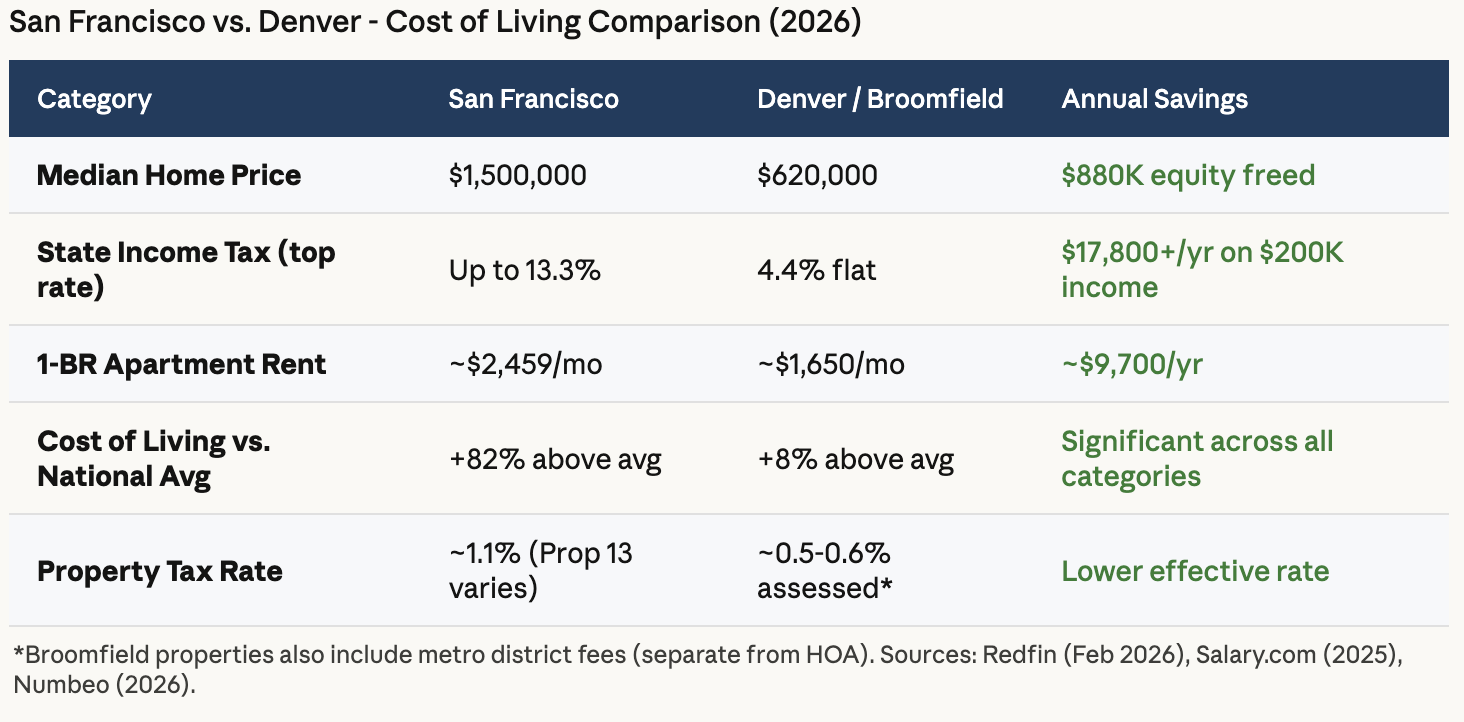
The headline figure is housing. <strong>The median San Francisco home sold for $1.5 million in February 2026</strong> (Source: Redfin). The median Broomfield home sold for approximately $620,000 over the same period (Source: Redfin, Zillow). That's a $880,000 gap. For a tech worker with meaningful equity in an SF property, selling and relocating isn't just a lifestyle upgrade - it's an equity arbitrage play that can eliminate your mortgage entirely or leave you with a small, highly manageable payment.
Beyond housing, <strong>San Francisco's cost of living runs approximately 22-30% higher than Denver's</strong> across all major categories (Source: Numbeo, March 2026; Expatistan, March 2026). A household spending $14,000 per month in San Francisco can maintain the same standard of living in Denver for roughly $12,200 per month - a savings of about $21,600 per year before taxes.
What the Tax Savings Actually Look Like
This is the number that gets people's attention. California taxes high earners hard. On a $300,000 household income, California's top marginal rate reaches 9.3% starting at $66,296 for single filers and 13.3% on income over $1 million. Colorado charges a flat 4.4% - full stop, no brackets, no phaseouts.
<strong>For a tech household earning $250,000 per year, moving from California to Colorado can reduce state income tax liability by $15,000-$22,000 annually</strong>, depending on filing status and deductions. That number compounds fast. Over five years, that's $75,000-$110,000 in retained income - more than enough to cover the entire cost of the move and then some.
There's also the capital gains angle. If you've owned a Bay Area home for more than two years, California taxes capital gains at your ordinary income rate (up to 13.3%). Colorado taxes them at the same flat 4.4%. Timing your move before you sell can be a meaningful financial decision, send me an email today!
Housing: What Your San Francisco Equity Buys in Broomfield
Let's run a real scenario. You're a software engineer in the Bay Area. You bought a 2/1 condo in the Sunset District in 2018 for $900,000 and it's now worth approximately $1.4M. After transaction costs and taxes, you walk away with $400,000-$500,000 in cash.
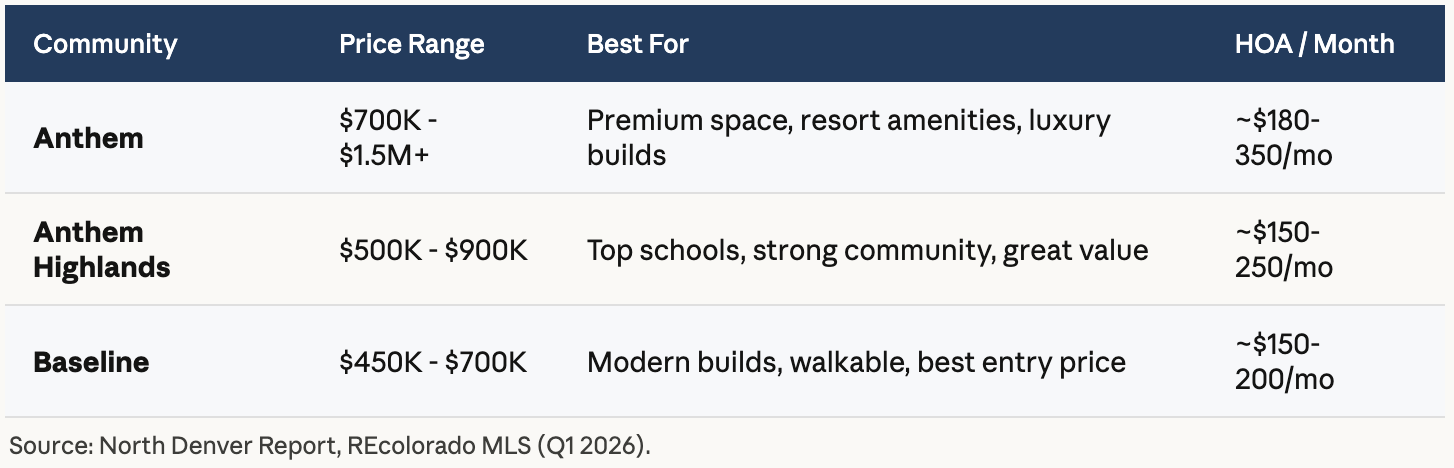
In Broomfield, that cash puts you in one of three master-planned communities with top-rated schools, mountain views, and resort-style amenities:
One thing Bay Area buyers consistently underestimate: what you get for $700K in Broomfield. I'm talking 4 bedrooms, 3 bathrooms, a 3-car garage, a finished basement, mountain views, and a backyard large enough to actually use. In San Francisco, $700K gets you a one-bedroom condo in a building that was built when the Nixon administration was still news.
The Tech Job Market: Can You Actually Work Here?
Short answer: yes, and it's gotten better. The Denver-Boulder tech corridor has matured considerably over the past decade. Major employers with significant Broomfield-area footprints include IBM (offices in Boulder and Broomfield), Oracle (Broomfield), Level 3 Communications (Broomfield), and dozens of aerospace and defense tech companies along the US-36 corridor.
For remote workers - which describes most of the SF tech workers I work with - the location question becomes about infrastructure and amenity support. Broomfield delivers on both:
Gigabit fiber internet is available throughout Anthem, Anthem Highlands, and Baseline
Denver International Airport is 35-45 minutes from Broomfield, with direct flights to SFO multiple times daily (critical for the "I still fly back once a month" crowd)
The Boulder tech scene is 20 minutes away for networking and co-working options
Downtown Denver is 25-30 minutes, with a walkable LoDo district that scratches the urban itch when you want it
<strong>54.8% of Anthem residents currently work from home</strong> - this is not a community built for the 9-to-5 downtown commute. It's built for people exactly like you. (Source: North Denver Report community research, 2025)
What's Different About Living in Colorado vs. San Francisco
I'll be direct about the adjustments, because they're real.
Weather: Denver gets 300+ sunny days per year - more than Miami. The winters are cold but not brutal, and the snow melts fast. The bigger adjustment is the altitude (5,280 feet in Denver, higher in Broomfield's northern communities) - give yourself 2-4 weeks to acclimate if you exercise heavily. The fog, the marine layer, the gray November skies of SF? Gone.
Space: The average new build in Anthem runs 2,800-4,500 square feet. For someone coming from a 1,000-square-foot SF condo, this takes actual adjustment. Rooms that you'll furnish over time. A yard that requires upkeep. This is a good problem, but it's a real one.
Hail: Colorado gets hail. Budget for it. Most homeowners replace their roof every 10-15 years. Make sure your insurance covers replacement cost, not actual cash value.
The Cultural Shift: San Francisco has a unique density of culture, food, and ideas that Denver doesn't fully replicate - yet. Denver's restaurant scene has improved dramatically, the arts community is growing, and the outdoor access is genuinely world-class. But if being steps from a Michelin-starred restaurant or an experimental theater on a Tuesday night is core to your identity, you're making a real trade-off. Most people I work with tell me six months in that the trade was worth it. But it's worth being honest about what you're leaving.
Colorado-Specific Buying Considerations for Out-of-State Buyers
A few things that trip up Bay Area buyers specifically:
Metro District Taxes: In Broomfield, your property tax bill has two line items - the county assessed tax rate and a metro district fee. Metro districts fund the infrastructure that was built to develop the community. This is not an HOA - it's a separate tax district. On a $700K Broomfield home, you might pay $6,000-$9,000/year in combined property tax and metro district fees. Still less than many comparable California properties, but you need to understand the full number before you budget.
Expansive Soils: Colorado's Front Range has clay soils that expand when wet and contract when dry. This causes foundation movement over time. Your home inspection must include a foundation evaluation, and you should ask sellers for any previous foundation repair documentation. This is not a dealbreaker - most homes are fine - but it's non-negotiable due diligence.
Radon: Colorado has elevated radon levels. Radon testing is standard in every Colorado home purchase. Mitigation, if needed, runs $800-$1,500 and is a simple fix. Just make sure it's in your inspection checklist.
Seller's Disclosure (SPD19): Colorado's seller disclosure form was rewritten effective January 2026. The new SPD19 is more detailed than the old form and covers items like metro district obligations, HOA documents, and known defects more thoroughly. Your agent should walk you through it line by line.
For the full Colorado buying process, read my <a href="https://youranthemhome.com/blog/how-to-buy-a-house-in-colorado">How to Buy a House in Colorado guide</a>.
What SF Tech Workers Ask Me Most
"Will I regret leaving?" The people who regret it are usually the ones who moved without a community plan - they got the bigger house but hadn't thought about how they'd make friends, where they'd hike, what their weekdays would feel like. The ones who thrive are intentional about it. Broomfield's master-planned communities make it easier than most places to plug in quickly.
"Should I rent first or buy?" If you have strong equity and a clear budget, buy. The Broomfield market is favorable to buyers right now - homes are sitting longer than they did in 2021-2022, and sellers are negotiating. If you're uncertain about the specific neighborhood or community, a 6-12 month rental in the area you're targeting is a smart call. I can point you toward rentals in all three communities.
"What about my RSUs?" California taxes RSU vesting as ordinary income. Once you're a Colorado resident, subsequent vesting events are taxed at 4.4%. Timing your relocation around a major vesting event can be significant. This is a conversation worth having with a CPA who understands multi-state taxation before you move - not after.
Ready to Run the Numbers on Your Specific Move?
I help SF and Bay Area tech workers relocate to Broomfield every week. I'll put together a personalized cost comparison using your actual income, your current home value, and specific communities in Broomfield that match your priorities - not a generic calculator, a real analysis.
Email Nick directly:NickAhrensRealestate@gmail.com
Browse listings:zillow.com/profile/NickAhrensRealEstate
Nick Ahrens is a Broomfield real estate expert with the North Denver Report, specializing in Anthem, Anthem Highlands, Baseline, and the North Denver metro.
Frequently Asked Questions
How much cheaper is Denver than San Francisco? Denver's overall cost of living is approximately 22-30% lower than San Francisco's. Housing is the biggest driver - the median SF home sold for $1.5M in February 2026 (Source: Redfin) versus roughly $620K in the Denver metro. A household spending $14,000/month in San Francisco can maintain the same lifestyle in Denver for about $12,200/month (Source: Expatistan, March 2026).
Do tech workers lose salary when moving from San Francisco to Denver? Remote tech workers typically keep their San Francisco salary when relocating to Denver. Even with a modest location-based adjustment, the net gain is usually substantial - Colorado's flat 4.4% income tax rate versus California's rate of up to 13.3% for high earners is the key driver.
What neighborhoods in Broomfield are best for SF tech workers? Anthem, Anthem Highlands, and Baseline are the three master-planned communities that match what Bay Area tech workers are looking for - strong schools, high-speed internet, mountain access, and a community of similarly-situated remote professionals. Anthem is the premium option (~$1M+ median), Anthem Highlands hits the sweet spot for schools and amenities (~$615K average), and Baseline offers the newest builds at the most accessible price (~$566K median).
Is Broomfield a good fit for remote tech workers? Yes. 54.8% of Anthem residents already work from home. The city has fiber internet throughout all three major communities, DIA is 35-45 minutes away for monthly SF trips, and the Boulder-Denver tech corridor provides networking and in-person co-working options when you want them.
How much home equity does a typical SF homeowner bring to Colorado? It varies by when you bought and what you own, but IRS migration data shows the average Santa Clara County mover to Broomfield carries a household income of $214,893 - and many arrive with $400K-$800K in equity depending on their SF purchase date. In Broomfield's $500K-$700K primary market, that equity frequently means a very small mortgage or no mortgage at all.