The Ultimate Guide to Moving from Texas to Colorado (2026 Edition)
Last Updated: March 2026 | By Nick Ahrens, North Denver Report
Texas is the single largest source of people moving to Colorado - accounting for 13.51% of all inbound moves to the state, more than California, Florida, or any other state (Source: HireAHelper Colorado Migration Report, 2025). If you're a Texan considering the move, you're in very good company. This guide covers everything you actually need to know: the real tax trade-off, which North Denver suburbs match the Texas lifestyle, what your home budget buys here, and the things that catch most Texas transplants off guard.
Why Are So Many Texans Moving to Colorado?
The top reasons Texas residents cite for relocating to Colorado cluster around four themes: outdoor access, climate preference, lifestyle upgrade, and - for a growing number of remote workers - simply wanting something different after years in a flat, hot landscape.
Colorado added 102,498 new out-of-state residents in the past year alone, and Texans represent the largest share of that group (Source: HireAHelper, 2025). The IRS migration data tells a similar story for Broomfield specifically: 93 Texas households file returns in Broomfield each year, with an average adjusted gross income of $111,935 - well above the national median, which means most Texans arriving here are financially stable professionals, not budget-driven movers.
The cities driving the most outbound Texans to Colorado are Dallas-Fort Worth, Houston, and Austin - exactly the metro areas experiencing the fastest-rising housing costs, worst traffic, and most extreme summer heat. Corporate relocations also play a role: the I-25 corridor between Denver and Fort Collins has become a landing zone for companies expanding out of Texas.
The Tax Trade-Off: Texas vs. Colorado - What You Actually Keep
This is the question every Texan asks, and it deserves a straight answer rather than a hedge.
Texas has no state income tax. Colorado has a flat 4.4% income tax. On a $200,000 household income, that's $8,800/year going to Colorado that Texas would have left in your pocket.
But property taxes tell the opposite story. Texas carries one of the highest property tax rates in the country - approximately 1.60% effective rate. Colorado's effective rate is approximately 0.49%. On the same $650,000 home:
Texas: ~$10,400/year in property taxes
Colorado (Broomfield): ~$3,185/year in property taxes
That's a $7,215/year swing in favor of Colorado on property taxes alone. For many Texans buying in the $600K–$900K range in Broomfield, the property tax savings partially or fully offset the income tax hit.
The complete picture when you factor in income tax, property tax, and sales tax - Colorado residents earning median household income take home $66,488 after all taxes vs. $56,961 in Texas (Source: MoverDB, 2025). That counterintuitive result is driven almost entirely by Texas's high property taxes offsetting its income tax-free advantage.

Sources: MoverDB (2025), Johnson & Starr Property Tax Analysis (2025), TurboTax State Tax Guide (2025)
The bottom line: If you're buying a home above $500K, Colorado's property tax advantage likely offsets or exceeds the state income tax you'll pay. If you're renting or buying below $350K, Texas wins on taxes.
What Your Texas Home Budget Buys in North Denver
This is where Texans either get excited or pause. Colorado's home prices are higher than most of Texas - the median home price in Broomfield is approximately $650,000 (December 2025), compared to roughly $380,000–$420,000 in most DFW suburbs.
However, context matters. If you're coming from Austin (median ~$550,000), the gap is much narrower. If you've been in Southlake or Westlake, Broomfield's Anthem community at a $1,027,238 median might actually feel familiar.
Here's how the North Denver submarkets compare:
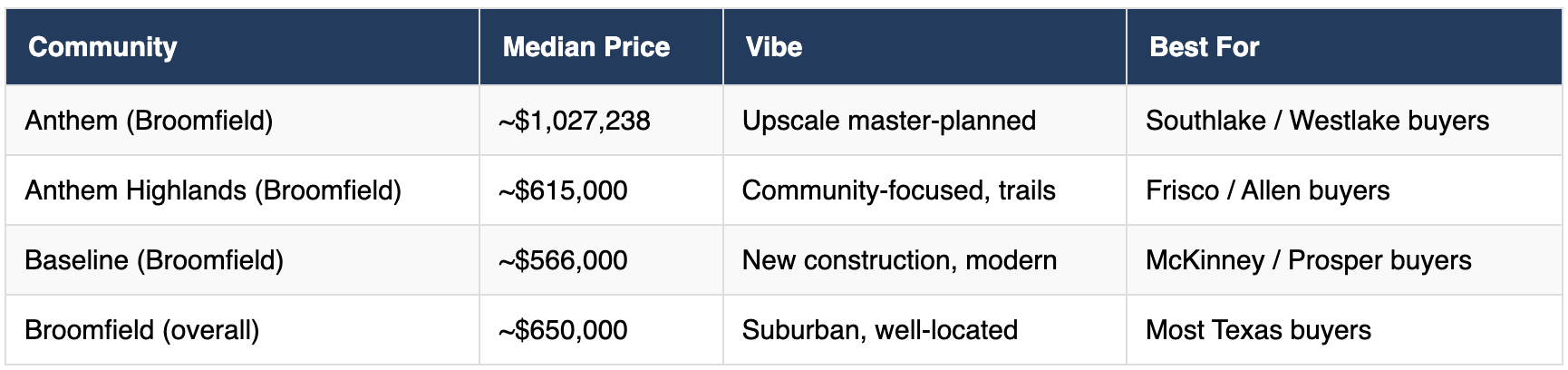
Source: REcolorado MLS, December 2025
The community that feels most familiar to Texas buyers, especially those from DFW master-planned suburbs, is Anthem Highlands. It has the same HOA-amenity model Texas buyers know: community pools, fitness center, miles of trails, and a rec center. And it sits at about 60% of Anthem's price point.
Want the full community comparison? Read: Anthem vs. Anthem Highlands vs. Baseline: The Definitive Comparison
The Best North Denver Suburbs for Texas Families
Texas families prioritize three things when choosing a suburb: good schools, community feel, and space to spread out. Here's how the North Denver options stack up - using a ranking methodology based on school ratings, walkability, park access, and home price per square foot.
Broomfield / Anthem Highlands is my top recommendation for most Texas families. The Boulder Valley School District and Adams 12 Five Star Schools both serve parts of Broomfield, with multiple schools rated 8–9/10 on Niche. The city is also one of the safest in Colorado, consistently ranking in the top 5% for low violent crime.
Louisville and Lafayette are worth a look for families who want a walkable downtown and a slightly more eclectic vibe - think McKinney's historic square but with better hiking on the doorstep. Home prices in Louisville average around $750,000–$850,000.
Arvada offers more affordable entry points ($550,000–$650,000 range) with easy access to both Denver and the mountains. It lacks the master-planned feel of Broomfield, but the Old Town area has genuine character.
Climate: What Texans Get Wrong About Colorado Weather
The most common misconception Texas transplants have is that Colorado is cold and snowy year-round. It isn't. Broomfield averages 300+ sunny days per year, more than Miami or Los Angeles. The winters are cold, but they're bright, and snowstorms typically clear within 24–48 hours.
What Texans aren't prepared for:
Altitude. Broomfield sits at approximately 5,344 feet. You'll feel short of breath the first week, especially during exercise. It normalizes quickly.
Low humidity. Coming from Houston or Dallas, the dry air is jarring. Your skin, sinuses, and wooden furniture will all need adjustment (humidifiers are standard in most Colorado homes).
Sun intensity at altitude. You sunburn faster here than in Texas. SPF is non-negotiable even in January.
Hail season. Colorado's Front Range has some of the highest hail frequency in the country, which affects homeowners insurance rates. Budget for this.
What Texans love immediately:
No 105°F summers. Denver's average July high is 88°F. Houston's is 94°F and significantly more humid.
The mountains are two hours away, but you can see them every single day from Broomfield.
"Warm enough to ski in the morning and eat on a patio in the afternoon" is a real Colorado experience.
City-by-City: Which Texas City Are You Coming From?
Moving from Dallas to Denver
Dallas to Denver is the most common Texas-to-Colorado corridor. DFW transplants tend to prioritize: master-planned communities, good school districts, and short commutes. The suburbs of Broomfield, Lone Tree, and Parker match that profile well. Broomfield's Anthem Highlands is the closest Colorado analog to Frisco or Allen.
Drive time: ~14–15 hours via I-40 West to I-25 North, or I-27 to Amarillo to I-25.
Moving from Austin to Denver
Austin transplants tend to be tech workers and entrepreneurs. They value lifestyle, outdoor access, and authenticity. Boulder gets a lot of Austin expats, but it's significantly pricier ($1M+ median). Broomfield sits between Boulder and Denver in both geography and price, and 54.8% of Anthem residents work from home, which means the remote-work community is established and real.
Drive time: ~15–16 hours via I-35 North to I-25 North, or more scenic routes through New Mexico.
Moving from Houston to Denver
Houston transplants often cite three reasons for leaving: heat, flooding risk, and traffic. Colorado solves all three. The one trade-off: you're giving up Houston's exceptional diversity of food, culture, and international community. Denver has improved dramatically over the past decade, but it's not Houston. If that matters to you, factor it in.
Drive time: ~14–15 hours via I-10 West to I-25 North, or I-35 through DFW.
The Relocation Timeline: How to Execute a Texas-to-Colorado Move
A well-executed move takes 90 - 120 days of lead time. Here's the sequence I walk my Texas clients through:
90 days out: Start the home search remotely. Set up a custom MLS search through a local agent (me) so you're seeing Broomfield and North Denver listings the moment they hit, not 48 hours later when Zillow updates.
75 days out: Schedule a 3-day scouting trip to Colorado. Tour neighborhoods, not just houses. Drive the commute at 8am. Eat in the town centers. Feel it.
60 days out: Get pre-approved by a Colorado lender (your Texas bank likely works here, but local lenders know the market quirks).
45 days out: Submit offers. Colorado's market is competitive but not insane, well-prepared buyers win.
30 days out: Book movers. Summer moves (May - August) fill up fast; book 6–8 weeks in advance.
2 weeks out: Update your address with Texas DMV, USPS, employer, and financial institutions.
Move-in week: Register your vehicle in Colorado within 90 days of establishing residency (required by law).
For a comprehensive step-by-step guide to buying in Colorado: How to Buy a House in Colorado: A 10-Step Guide
What Most Texas-to-Colorado Guides Get Wrong
Every generic relocation article tells you to "research neighborhoods" and "compare cost of living." Here's what they skip:
HOA structures are different. Many Texas master-planned communities have MUDs (Municipal Utility Districts) that add $150–$400/month on top of HOA fees. In Colorado, Broomfield's equivalent is Metro Districts, and they work similarly. Don't assume you're escaping the extra charges. Metro District Taxes in Broomfield Explained is worth reading before you shop.
Colorado title insurance works differently. In Texas, title insurance rates are set by the state. In Colorado, they're negotiated. Ask your agent who pays what before you sign a contract.
The inspection period is king. Colorado buyers typically get 10 days for inspections, with significant leverage to negotiate repairs or walk away. Use it. Don't waive it.
Schools within a district aren't all equal. Colorado's open enrollment policy means you can apply to schools outside your attendance boundary, which matters because quality varies even within great districts.
Ready to Plan Your Move From Texas?
I work with Texas families and professionals relocating to Broomfield and the North Denver metro every week. Most of my Texas clients start the same way: they need someone who knows both what they're leaving and what they're getting into.
I'll build you a custom neighborhood comparison based on your budget, school priorities, and commute - and I'll tell you the things you won't find in a Zillow listing.
📧 Email Nick directly: NickAhrensRealestate@gmail.com 🏠 Browse listings: zillow.com/profile/NickAhrensRealEstate
Nick Ahrens is a Broomfield real estate expert with the North Denver Report, specializing in Anthem, Anthem Highlands, Baseline, and the North Denver metro.
Frequently Asked Questions: Moving from Texas to Colorado
Is moving from Texas to Colorado worth it financially? It depends on your income and home price. Texas has no state income tax, but Colorado's 4.4% flat income tax is partially offset by significantly lower property taxes, Colorado's effective rate is ~0.49% vs. Texas's ~1.60%. Analysis of median household incomes shows Colorado residents take home more after all taxes combined: $66,488 vs. $56,961 in Texas (Source: MoverDB, 2025).
What is the best Denver suburb for people moving from Texas? Broomfield specifically the Anthem, Anthem Highlands, and Baseline communities, consistently tops the list for Texas transplants. The master-planned community feel mirrors what Texas families know from Frisco, Southlake, and The Woodlands: HOA-managed amenities, top-rated schools, and new construction. Anthem's median home price is approximately $1,027,238, while Baseline offers newer homes starting around $566,000.
How far is Dallas from Denver by drive? Approximately 1,020 miles, roughly 14 - 15 hours via I-25 North. Austin to Denver is approximately 1,080 miles (15 - 16 hours), and Houston to Denver is approximately 1,020 miles.
Do I need to prepare for altitude when moving from Texas to Colorado? Yes. Broomfield sits at approximately 5,344 feet above sea level. Most people experience mild adjustment symptoms for 1–2 weeks: fatigue, slight shortness of breath, and increased thirst. It normalizes quickly for most healthy adults.
How much do homes cost in North Denver suburbs compared to DFW? The median home price in Broomfield is approximately $650,000 (December 2025), compared to roughly $380,000 - $420,000 in most DFW suburbs. However, Broomfield's dramatically lower property tax rate narrows the true monthly cost gap more than the sticker price suggests.
Also on the North Denver Report: