15 Things I Wish I Knew Before Moving from California to Colorado
Last Updated: April 2026
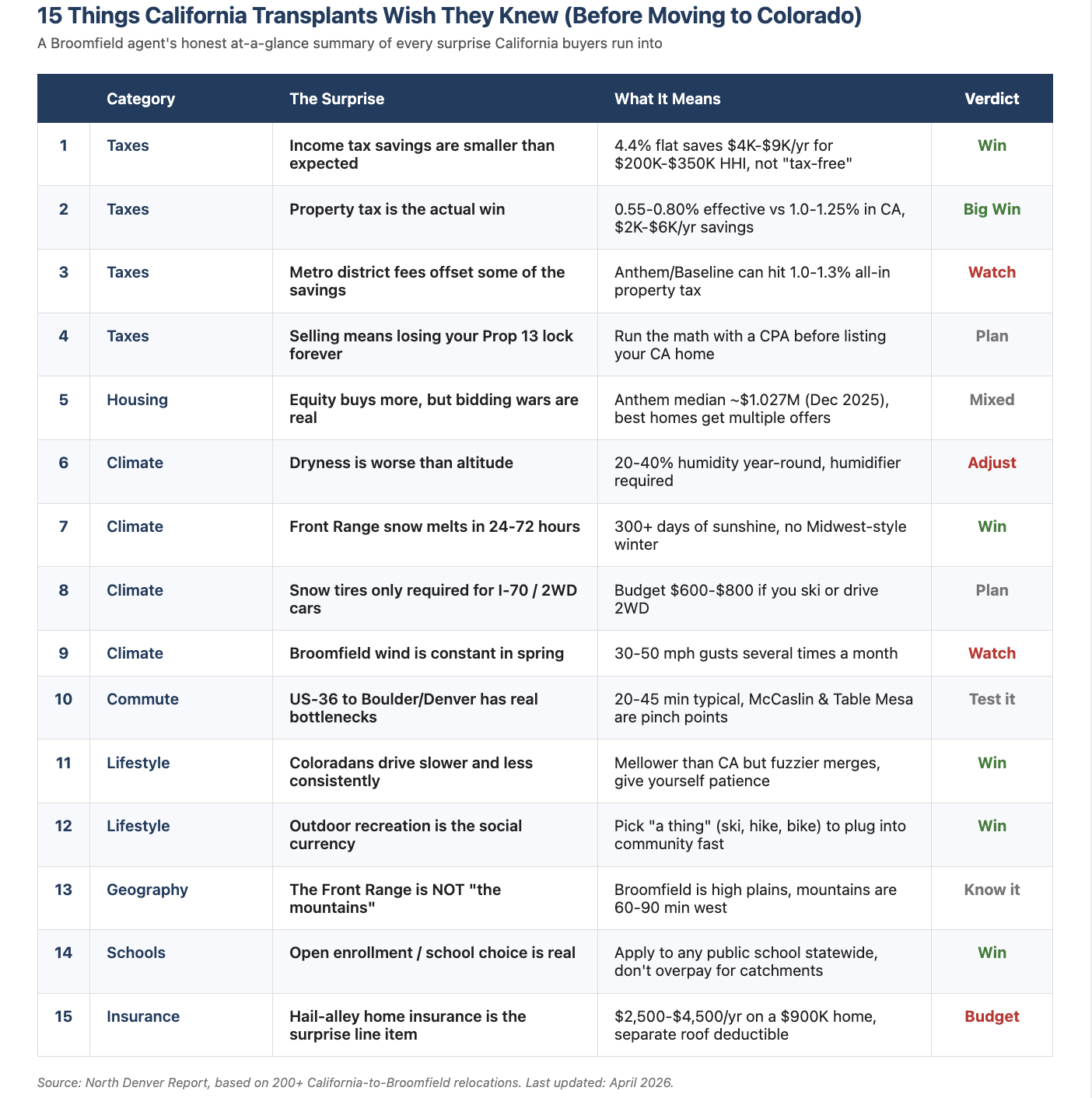
I help California families move to Broomfield almost every week, and after a couple hundred of these relocations, I can tell you the same 15 things come up over and over. Some are good surprises. Some sting. All of them are easier to handle when you know about them before you sign a purchase contract, not after. Here's the honest list, from a Broomfield agent who has walked dozens of California buyers through this exact transition.
If you only remember one thing: the move usually works out, but the people who love it most are the ones who came in with realistic expectations.
1. Your tax savings are real, but smaller than you think
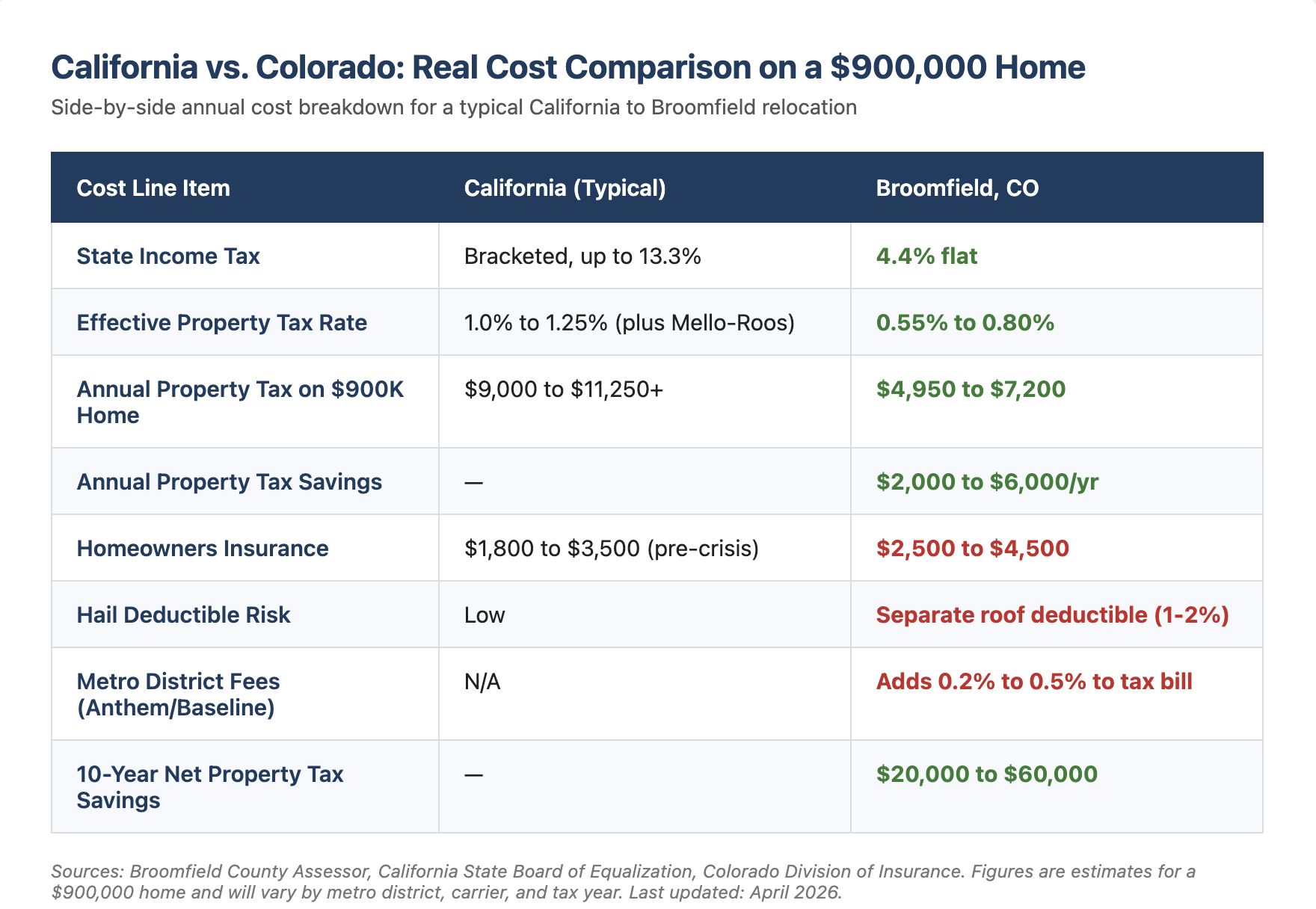
Colorado has a flat 4.4% state income tax. California has a bracketed system that tops out at 13.3%. On paper that looks like a massive win, and for very high earners it is. But for a household making $200,000 to $350,000, the actual annual income tax savings are usually in the $4,000 to $9,000 range, not the "I'll never pay tax again" fantasy people show up with.
The bigger savings hide somewhere else. Keep reading.
2. Property tax is the actual win, not income tax
This is the line item nobody talks about until closing. A typical California home runs an effective property tax rate of 1.0% to 1.25%, and that's before Mello-Roos in newer communities. Broomfield's effective rate runs roughly 0.55% to 0.80% depending on the metro district (Source: Broomfield County Assessor).
On a $900,000 home, that's a difference of $2,000 to $6,000 per year, every year, forever. Over a 10-year hold, you can buy a really nice car with what you save on property tax alone. This is the financial argument that makes Colorado work for California buyers in the $700K-$1.2M range.
3. Mello-Roos is gone, but metro district fees are not
Don't celebrate the absence of Mello-Roos before you understand metro districts. Newer Broomfield communities, Anthem and Baseline included, are inside special metro districts that levy additional mill levies to pay for parks, roads, and infrastructure bonds. The all-in property tax bill in a metro district can land closer to 1.0% to 1.3%, which is still lower than California, but it's not the 0.5% headline you see on Zillow.
I always pull the actual mill levy and metro district debt schedule before showing a home in these communities. It's the single biggest "wait, what?" moment for California transplants if their agent doesn't surface it early.
4. The day you sell your California home, your Prop 13 lock is gone forever
This one is emotional, not financial. If you've owned in California for 15+ years, your Prop 13-locked tax basis is one of the most valuable financial assets you have. The moment you sell to fund the Colorado move, you give up the option to ever go back to that low basis.
I'm not saying don't move. I'm saying go in with your eyes open, and run the math on whether keeping a California rental and buying smaller in Colorado makes more sense than a clean break. For some clients it does. For most, it doesn't, but it's worth a 30-minute conversation with a CPA before you list.
5. Your equity buys you more house than you think, but you'll still get into bidding wars
The fantasy: you sell your 1,400 sq ft Bay Area bungalow for $1.6M, walk into a $900K home in Anthem with no mortgage, and pocket $700K. The reality: you sell your $1.6M home, pay 6% in selling costs and capital gains over the exclusion, walk into a $900K home in Anthem, and pocket $500K-$600K, which is still life-changing.
Just don't expect to lowball your way into a Broomfield purchase. Inventory is tight. Anthem's median sits around $1,027,000 (December 2025), and the best homes still see multiple offers within the first week. Cash-strong California buyers win a lot of these, but you have to actually compete.
6. Altitude adjustment is real, and the dryness is worse than the altitude
Coming from sea level California, plan on one to three weeks of feeling slightly off. Mild headaches, poor sleep, dehydration. Coffee hits weird. One beer feels like two. Your nose will bleed at random. This is normal and it passes.
The thing nobody warns you about is that the dryness doesn't pass. Colorado's relative humidity sits in the 20-40% range most of the year compared to coastal California's 60-80%. You will need lotion, lip balm, and a humidifier in your bedroom from October through April. Buy the humidifier on day one, not after the first nosebleed.
7. Snow on the Front Range melts fast, and that changes everything
If your image of winter is the Northeast or Midwest, you're going to be pleasantly surprised. Front Range Broomfield gets snow, but it usually melts within 24 to 72 hours because of how much sun we get (Colorado averages roughly 300 days of sunshine per year, and that's not marketing). You will not spend your weekends shoveling for months.
What you will deal with: dramatic temperature swings. A 65-degree afternoon can flip to 25 degrees and snowing by morning. Layers are your new permanent wardrobe.
8. You don't necessarily need snow tires, but you do need to think about it
Here's the honest answer most agents won't give you: if you have AWD with decent all-season tires, you can survive a Broomfield winter without dedicated snow tires. If you drive a 2WD sedan, you should budget $600-$800 for a snow tire set. If you plan to ski I-70 regularly, snow tires are non-negotiable, and Colorado's Traction Law actively requires adequate tires or chains during winter conditions on I-70.
A lot of California transplants try to skip this, ski one weekend in February, and end up white-knuckling Floyd Hill in a panic. Don't be that person.
9. The wind in Broomfield is a real thing
Browse r/Broomfield for ten minutes and you'll see the same complaint: "Why is it so windy?" The answer is geography. Broomfield sits on the Front Range plateau, and downslope winds off the foothills funnel through here regularly. Late winter and spring are the worst stretches, and 30 to 50 mph gusts happen several times a month.
It is not constant. It is not every day. But if you're touring Anthem on a calm Saturday and falling in love with a hilltop lot, mentally add 20 mph of average wind and ask yourself if you still love it. Some of my clients do. Some pivot to a more sheltered street.
10. The US-36 commute to Boulder is real, and you should test-drive it
Broomfield to downtown Boulder is 20 to 35 minutes on US-36, depending on the hour. Broomfield to downtown Denver is 25 to 45 minutes. Those are the median numbers. The reality is that US-36 has chronic bottlenecks at McCaslin Boulevard and Table Mesa, and accidents on this corridor are common enough that one bad morning can double your commute.
If you're moving for a job in Boulder or downtown Denver, I always tell clients to fly out for a Tuesday or Wednesday and drive the actual commute at the actual time before they pick a neighborhood. It's the single best 30 minutes of due diligence you can do.
11. Coloradans drive differently than Californians, and not in the way you think
California drivers are aggressive but predictable: everyone is in a hurry, everyone knows the rules, lane changes are crisp. Colorado drivers are mellower but less consistent. People drive slower in the left lane. Merges are politer but fuzzier. Snow brings out two extremes: people who absolutely cannot drive in it, and people who think their lifted truck is invincible.
Give yourself a few months of extra patience. The good news is that road rage incidents are rarer here.
12. Outdoor recreation is the social currency
In California, the social glue is often work, food, and culture. In Broomfield and the broader Front Range, the social glue is what you do outside. You don't have to become a triathlete, but having "a thing", whether that's hiking, biking, skiing, climbing, trail running, or just walking the open space trails, will plug you into the community much faster than waiting for neighbors to invite you over.
This is especially true if you're in your 30s or 40s with no kids in school yet. The fastest path to friends is a Saturday morning group activity.
13. The Front Range is not "the mountains"
This one trips up so many California buyers that I now bring it up on the first call. Broomfield is on the high plains. The mountains are a 60 to 90 minute drive west. You can see them from your front porch on a clear day, and they are stunning, but you don't live in them.
If your dream is to walk out your back door into pine trees, Broomfield is not that place. You're looking at Evergreen, Conifer, or Nederland for that, which are beautiful but come with their own tradeoffs (longer commutes, well water, wildfire risk, harder winters). For most California families, Broomfield's "mountains 90 minutes away, city 25 minutes away" balance is the sweet spot, but you should know what you're buying.
14. School choice in Colorado actually works
Colorado has open enrollment, meaning you can apply to any public school in the state, not just your neighborhood school, subject to space availability. Boulder Valley School District (which serves parts of Broomfield) and Adams 12 (which serves the rest) both participate.
In practical terms, this means you don't have to overpay for a specific elementary school's catchment the way you would in parts of California. You can buy in a more affordable Broomfield neighborhood and apply to the school you actually want. It's not guaranteed, popular schools fill up, but the system is real and it works. I've helped multiple California families use this exact strategy.
15. Home insurance is the surprise line item nobody warns you about
This is the cost most California transplants don't see coming. Colorado is in "hail alley," and homeowners insurance premiums have climbed sharply over the last five years. A $900,000 home in Broomfield can run $2,500 to $4,500 a year in insurance, often more than what California buyers were paying on a similarly priced home (excluding the post-fire California insurance crisis exceptions).
You'll also want to ask about hail deductibles, which are often a separate (higher) percentage on the roof. None of this is a deal-breaker, but it's a real $1,000 to $2,000 a year line item to factor into your monthly housing budget. I walk every client through this before they write an offer.
The honest summary
Most California families I help end up loving Broomfield. The space, the schools, the sunshine, the financial breathing room, all real. The ones who struggle are usually the ones who expected zero adjustment, no bidding wars, and Northern California weather without the price tag.
Come in with realistic expectations on these 15 items, and the move usually goes great. If you're in the research phase right now, the Ultimate Guide to Moving to Broomfield is a good next read, and so is the deeper Moving from San Francisco to Denver Tech Worker's Guide if you're in the Bay Area, or the Moving from Los Angeles to Denver Playbook if you're in SoCal. For the financial deep dive, see Property Taxes in Broomfield Colorado: A Complete Guide and the Complete Guide to the Anthem Community.
Ready to see Broomfield through a Californian's eyes?
I help California families relocate here every week. I'll build you a custom neighborhood tour based on your priorities, walk you through the real tax and insurance numbers for a home in your range, and tell you the same honest stuff you just read, in person.
📧 Email Nick directly:NickAhrensRealestate@gmail.com
🏠 Browse listings:zillow.com/profile/NickAhrensRealEstate
📺 Watch the video tours:youtube.com/@NorthDenverReport
Nick Ahrens is a Broomfield real estate expert with the North Denver Report, specializing in Anthem, Anthem Highlands, Baseline, and the North Denver metro.
Frequently Asked Questions
Will I actually save money moving from California to Colorado? Most California buyers save on housing and property tax, not income tax. Colorado's flat 4.4% state income tax is lower than California's bracketed system for high earners, but the bigger win is property tax: Broomfield's effective rate runs roughly 0.55% to 0.80%, while a typical California home runs 1.0% to 1.25% with Mello-Roos. On a $900,000 home, that's a difference of several thousand dollars a year, every year.
How bad is altitude adjustment in the Denver area? Most people from sea level feel the altitude for one to three weeks, with mild headaches, poor sleep, and dehydration being the most common symptoms. The bigger long-term adjustment is the dryness, not the altitude. Plan to drink more water than feels reasonable, run a humidifier in winter, and expect alcohol to hit harder than it did in California.
Do I really need snow tires in Broomfield? If you have AWD with decent all-season tires, you can usually get by in Broomfield without dedicated snow tires. If you drive a 2WD car or want to ski I-70 in winter, snow tires are worth the roughly $600 investment. Colorado's Traction Law on I-70 in winter requires adequate tires or chains, and rental cars are not exempt.
Is the wind in Broomfield really that bad? Yes, the wind is real, especially in late winter and spring. Broomfield sits on the Front Range plateau where downslope winds funnel off the foothills, and 30 to 50 mph gusts are not unusual several times a month. It's the most consistent local complaint on Reddit, and worth knowing before you fall in love with a hilltop lot.
What's the commute from Broomfield to Boulder or Denver actually like? Broomfield to downtown Boulder runs about 20 to 35 minutes on US-36 depending on the time of day, and Broomfield to downtown Denver runs about 25 to 45 minutes. The McCaslin and Table Mesa stretches of US-36 are the bottlenecks, and accidents are common enough that I always tell clients to test-drive their commute before committing to a neighborhood.