Moving from Austin to Denver: A Tech & Lifestyle Comparison (2026)
Last Updated: March 2026
Moving from Austin to Denver is one of the most nuanced relocation decisions a tech professional can make right now. Both cities are thriving, educated, and packed with opportunity. The real differences come down to taxes (the math is not what you expect), climate (it goes much deeper than weather), and lifestyle infrastructure - specifically whether mountains matter to you. This guide runs the real numbers and lays out what actually changes when you cross the Texas-Colorado state line.
Austin vs. Denver: The Core Trade-off
Austin and Denver attract similar people: remote tech workers, early-stage employees with equity, and growing families who want space without sacrificing city energy. But they've made very different deals with their residents.
Austin's deal: no state income tax, warm weather year-round, a world-class food and music scene, and a housing market that has corrected significantly since its 2022 peak. Austin's median home price was $520,000 in February 2026, down roughly 10% from peak levels (Source: Redfin, February 2026).
Denver's deal: a 4.4% flat state income tax, but dramatically lower property taxes, 300+ sunny days per year with low humidity, and the Rocky Mountains accessible from your driveway. Broomfield's median home price is approximately $650,000, with the master-planned communities I specialize in ranging from $566,000 (Baseline) to $1,027,238 (Anthem).
Neither city is "better." But depending on your income level, family size, and whether you ever want to ski on a Tuesday in January, one of them fits your life significantly better than the other.
The Tax Math: It's More Complicated Than "Texas Has No Income Tax"
This is the section everyone gets wrong.
Texas has no state income tax, full stop. The Texas Constitution makes it permanent. On a $150,000 salary, you keep $6,600 more per year than you would in Colorado, where the flat 4.4% rate applies to all income (Source: Colorado Department of Revenue).
But here's what the no-income-tax narrative skips: Texas pays for everything through property taxes, and they are high. Austin's combined property tax rate runs approximately 1.9% to 2.1% of appraised value annually, covering the City of Austin, Travis County, and school district levies (Source: Travis County Appraisal District, 2025-2026).
Colorado, by contrast, has some of the lowest property tax rates in the country. In Broomfield, the effective rate ranges from approximately 0.55% to 0.80% of assessed value depending on which metro district your home sits in - and that spread mostly reflects which metro district-funded amenities you're buying into (Source: Broomfield County Assessor).
Here is what that means in dollars:
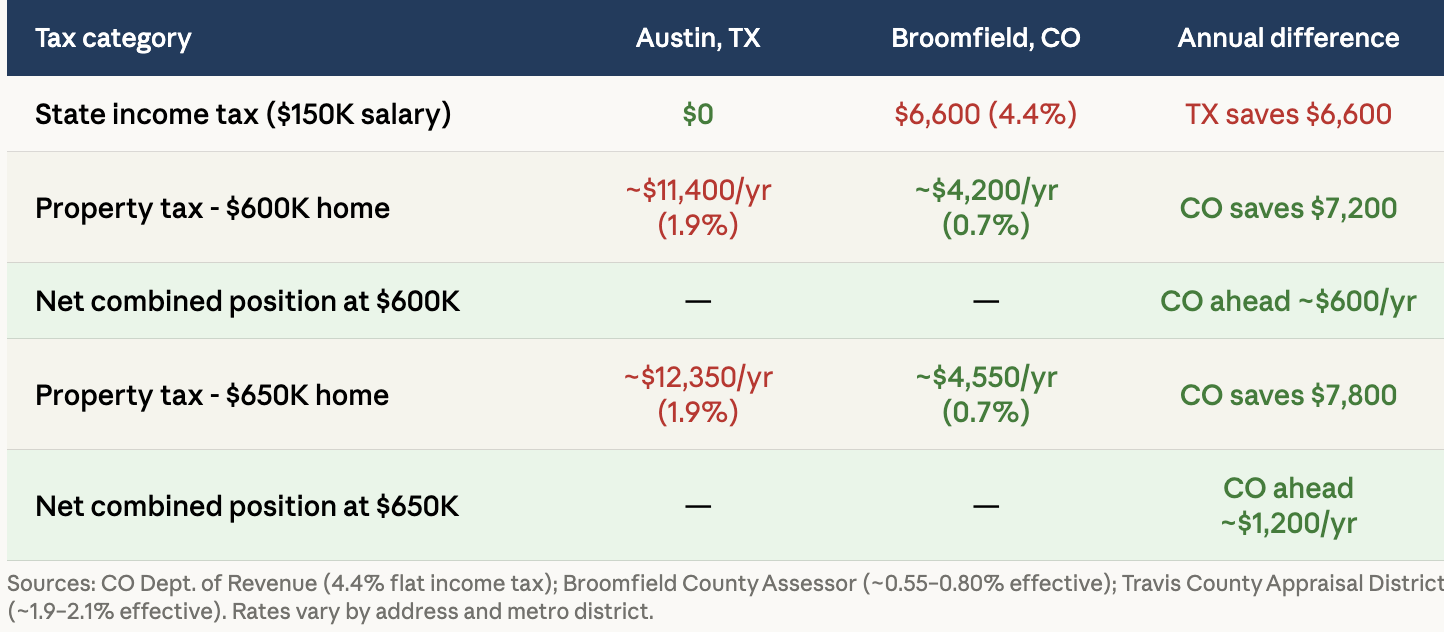
Note: Property tax estimates are approximate. Broomfield rates vary by metro district. Consult the Broomfield County Assessor for your specific address. Colorado income tax rate: 4.4% flat (Colorado Department of Revenue, 2026).
The short version: the higher your home purchase price, the more Colorado's property tax advantage compresses or eliminates the income tax penalty. At a $650,000 home with a $150K salary, Colorado and Texas are essentially even on combined state tax burden. At higher home values, Colorado pulls ahead.
Home Prices: Austin vs. Broomfield
Austin's housing market has corrected meaningfully from its 2022 peak. The city of Austin median was $520,000 in February 2026, down roughly 18% from the May 2022 high of $550,000 (Source: Redfin, February 2026). The broader Austin metro median sits lower, around $412,000-$435,000, reflecting suburban and outlying county pricing.
Broomfield, by comparison, sits around $650,000 at the metro median. But Broomfield's three master-planned communities offer a wider price range than you'd expect:
Sources: Anthem - December 2025 MLS data. Anthem Highlands and Baseline - Q4 2025 MLS averages. Austin city median - Redfin, February 2026.
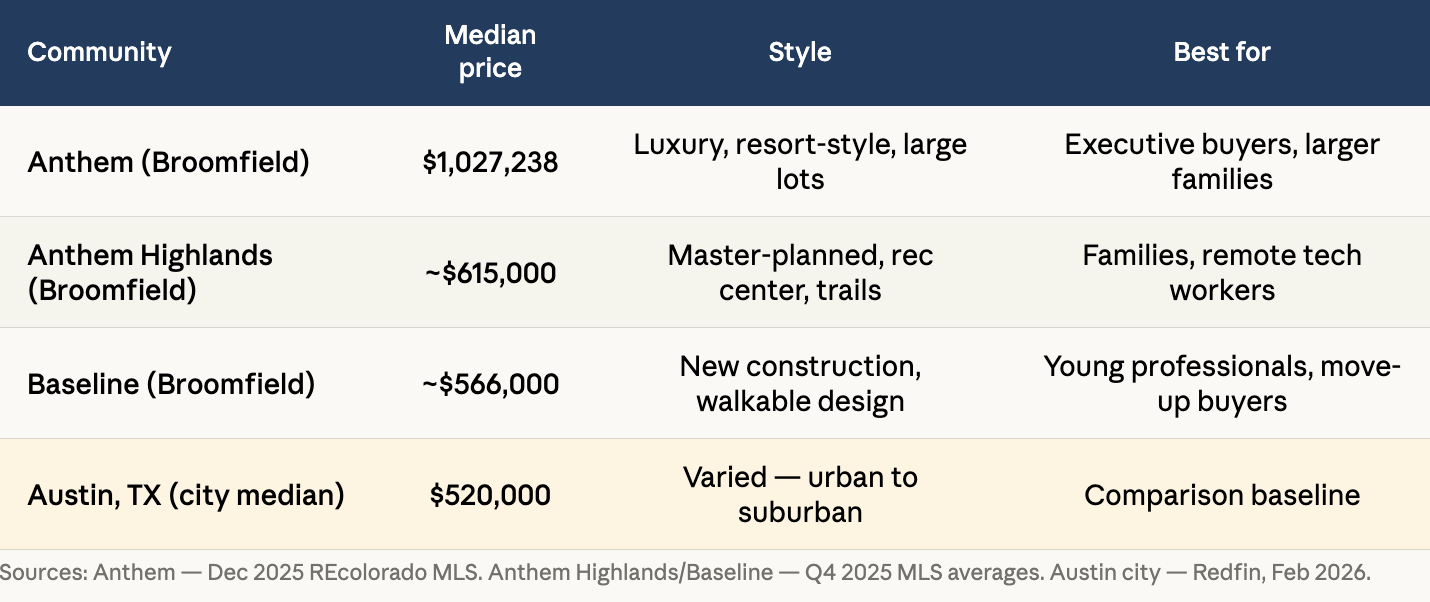
The Baseline and Anthem Highlands price points are competitive with what Austin proper is trading at, with the significant property tax advantage factored in above.
Climate: Heat vs. Altitude
This is where the conversation gets personal, and Austin transplants consistently tell me it is the factor they most underestimated.
Austin summers are long and brutal. The city averages over 100 days per year above 90 degrees Fahrenheit, with humidity that makes the "real feel" significantly worse. Data from climate risk research indicates Austin is projected to see a 228% increase in days over 108 degrees Fahrenheit over the next 30 years (Source: First Street Foundation via Redfin). That is not a small quality-of-life concern for families with kids who want to use their backyard from June through September.
Denver, by contrast, averages approximately 300 sunny days per year with dramatically lower humidity. A 90-degree day in Denver is a comfortable day. Summer evenings are routinely in the 60s, and air conditioning is optional for many Broomfield residents from June through August. There are real winters - Broomfield typically sees 8-12 snowstorms per year - but after growing up in Texas, most Austin transplants tell me they find the novelty deeply satisfying rather than burdensome.
The altitude adjustment is real. Broomfield sits at approximately 5,400 feet. Most people need 2-4 weeks to fully acclimate - expect to feel slightly winded and to drink significantly more water than you do in Austin. The effects are minor and temporary for most healthy adults.
Tech Jobs: Austin's Lead vs. Denver's Momentum
Austin has a legitimate claim as one of the top tech metros in the country. Approximately 16.3% of Austin's jobs are tech-related, with major employers including Dell Technologies (headquartered there), Apple, Tesla, Google, IBM, and Oracle. The city has strong venture capital density and a growing startup ecosystem that benefits from no state income tax.
Denver's tech market is smaller but growing quickly. Denver ranks #8 nationally among tech markets, with over 129,000 tech professionals and 14,420 new tech jobs added over the past five years (Source: CBRE Tech Talent Report via Denver startup ecosystem data). Major employers include Google, Amazon, Salesforce, and Charles Schwab, plus a dense aerospace and defense cluster (Lockheed Martin, Raytheon, Ball Aerospace) that does not exist in Austin at the same scale.
The practical difference for remote workers: neither city's job market matters all that much if your employer is in San Francisco. What matters is quality of life, timezone (both are Mountain/Central, giving you overlap with both coasts), and where you want to raise your family.
Outdoor Lifestyle: The Factor That Actually Decides It
I'll be direct about this: the mountain access question is the real tiebreaker for most Austin-to-Denver moves. Austin has Hill Country, which is genuinely beautiful, and Barton Springs, and a handful of lakes. It is not the Rockies.
From Broomfield, I can be at Eldora Mountain Resort in 45 minutes, Breckenridge in 75 minutes, or on a trailhead in Boulder in 20 minutes. The amount of outdoor recreation accessible on a normal Saturday - hiking, skiing, mountain biking, paddleboarding in the summer at Chatfield - is genuinely different in scale than what Austin can offer.
For the specific buyer I work with most often - a 35-50 year old tech professional with kids, a remote or hybrid job, and a desire to actually use their weekends - this is frequently the factor that closes the decision. 54.8% of Anthem residents work from home (Source: Anthem community data). That number reflects why Broomfield, specifically, attracts this buyer profile.
What Austin Actually Does Better
A fair comparison requires honesty about what you are giving up.
Food and nightlife: Austin's food scene is legitimately exceptional. The live music infrastructure, the breakfast taco culture, the barbecue (and if you know, you know that Franklin's alone is a reason to visit), and the dining density in central Austin is harder to replicate in Broomfield. Denver has a solid restaurant and brewery scene - Broomfield proper is more suburban - but Austin wins this category.
No state income tax: For high earners above $250,000, the income tax difference becomes harder to offset through property tax savings alone. At $250,000 in income, Colorado collects $11,000 more per year than Texas. Property tax savings on a $1M home at 0.7% vs. 1.9% would be approximately $12,000 per year, so it still roughly works out - but the math tightens.
Networking density: Austin has built a critical mass of founder and VC culture that Denver is still developing. If you are actively raising money or need warm intros to large tech employers, Austin's ecosystem has more depth.
Price: In an apples-to-apples comparison where you are buying at Austin's median price ($520K) versus Broomfield's median ($650K), you are starting $130,000 higher in Colorado. That is a real cash difference.
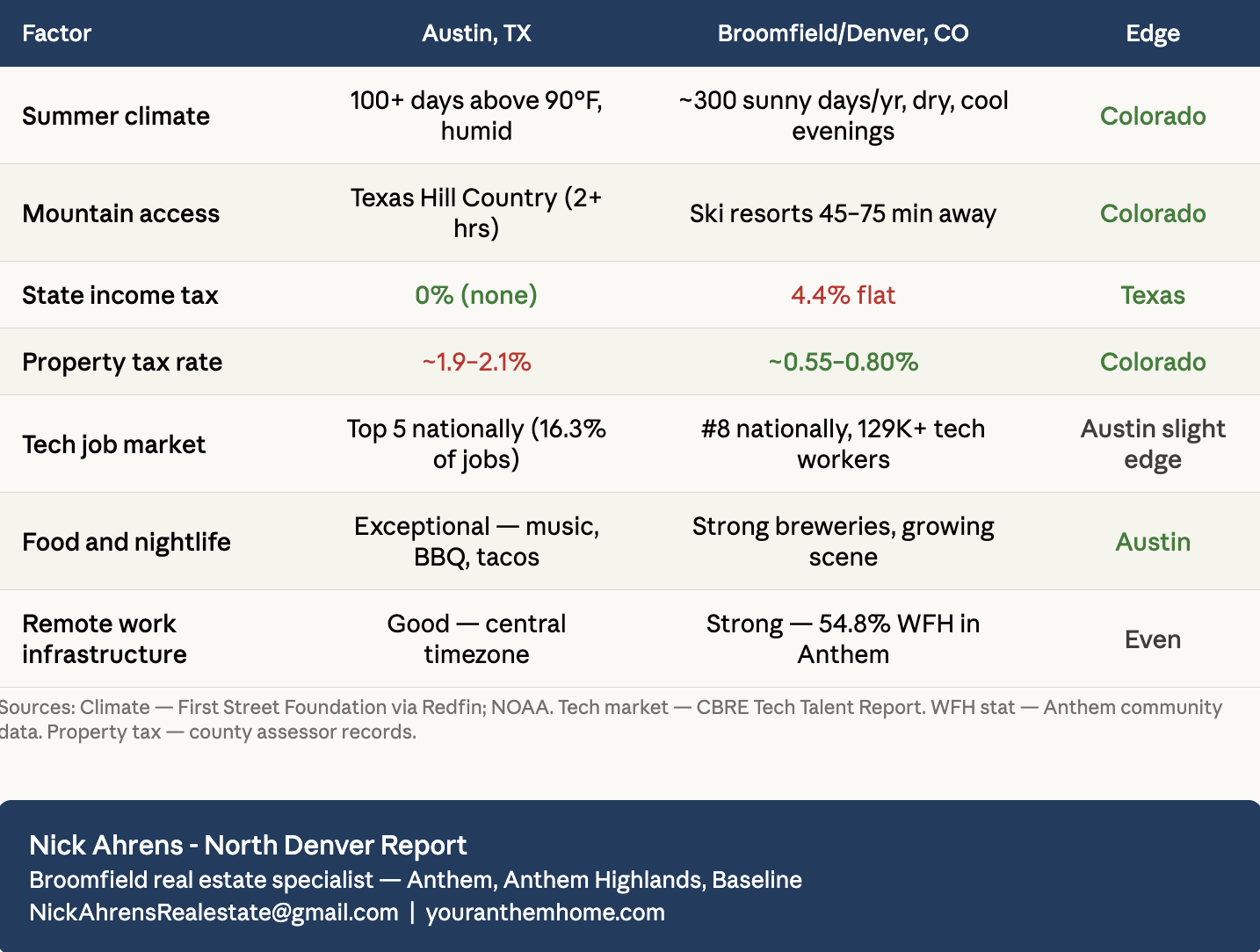
The Move That Makes Sense vs. The One That Doesn't
The Austin-to-Broomfield move makes sense if:
You want mountains within 45 minutes, not just proximity to them
You are tired of 100+ degree summers with humidity
You are buying at $600K+, where the property tax advantage compresses the income tax penalty
Your job is remote and you value outdoor lifestyle as a non-negotiable
You have kids and want the school quality and community infrastructure of Anthem, Anthem Highlands, or Baseline
The Austin-to-Broomfield move probably does not make sense if:
You are a single professional who thrives in Austin's nightlife and food density
You earn $300K+ and the $11,000+ annual income tax difference is material to your financial plan
You genuinely love heat and outdoor weather in October through May
Your employer requires you to be in-person in Austin
Internal Links
Anthem vs. Anthem Highlands vs. Baseline: The Definitive Comparison
Moving from Dallas to Denver: The Corporate Relocation Playbook
Ready to run the real numbers on your Austin-to-Broomfield move?
I work with Austin transplants regularly - the tax math, the neighborhood fit, the school district walkthrough. I'll pull a custom comparison based on your actual income level and the home price range you are targeting, so you can make this decision with real data instead of general estimates.
📧 Email Nick directly:NickAhrensRealestate@gmail.com
🏠 Browse Broomfield listings:https://www.zillow.com/profile/NickAhrensRealEstate
🌐 Read more at: youranthemhome.com
Nick Ahrens is a Broomfield real estate expert with the North Denver Report, specializing in Anthem, Anthem Highlands, Baseline, and the North Denver metro.
Frequently Asked Questions
Is it more expensive to live in Denver than Austin? Denver's overall cost of living runs approximately 10-29% higher than Austin depending on the metric used, with housing being the biggest driver. Austin's median home price is around $520,000 (Redfin, February 2026) versus $650,000 for the Broomfield area. However, Colorado's property taxes are dramatically lower - roughly 0.55-0.80% effective rate in Broomfield versus Austin's approximately 1.9-2.1% - which partially or fully offsets the higher home prices for most buyers in the $550,000-$700,000 range.
Does moving from Austin to Denver cost more in taxes? Texas has no state income tax, while Colorado charges a flat 4.4%. On a $150,000 salary, that is $6,600 more per year in Colorado. However, Colorado's property tax rates are dramatically lower. On a comparable $560,000 home, you would pay roughly $3,920/year in Broomfield (0.7%) versus $10,640/year in Austin (1.9%) - a property tax savings of $6,720 that nearly offsets the income tax difference entirely. The higher the home value, the more Colorado's property tax advantage grows.
What are the best neighborhoods in Broomfield for Austin transplants? Austin transplants consistently gravitate toward Broomfield's three master-planned communities: Anthem (median $1,027,238 - luxury, resort-style), Anthem Highlands (average $615,000 - highly amenitized, family-focused), and Baseline (median $566,000 - newest community, modern walkable design). All three feel familiar to Austin-area suburban residents but add easy Rocky Mountain access that Central Texas simply cannot match.
How does Denver's tech job market compare to Austin's? Austin leads with approximately 16.3% of jobs in tech, driven by Dell, Apple, Tesla, Google, and IBM. Denver ranks #8 nationally with over 129,000 tech professionals, strong in aerospace, clean energy, biotech, and SaaS. For remote workers already employed, both cities work well on timezone and cost-of-living grounds. Denver's outdoor lifestyle premium is frequently the deciding factor.
How is Colorado weather different from Austin? Austin averages 100+ days above 90 degrees per year with significant humidity, and climate data projects a 228% increase in extreme heat days over the next 30 years. Denver averages approximately 300 sunny days per year with low humidity - a 90-degree day feels dramatically cooler than Austin's 90 degrees. Colorado has real winters, but Broomfield residents consistently describe the trade-off as highly favorable after years in Central Texas heat.