A Guide to Reading a Seller's Property Disclosure in Colorado
Quick answer: A Colorado Seller's Property Disclosure (SPD) lists the known defects and conditions a seller must disclose. The current form, SPD19, became mandatory on January 1, 2026 and is 14 pages long. Read it for past repairs and red flags, but remember it is not an inspection report or a warranty.
By Nick Ahrens, Colorado real estate broker license FA.100104470, eXp Realty
Last Updated: February 2026
Colorado's Seller's Property Disclosure (SPD) form is a legal document that requires sellers to disclose known defects and conditions about their property. The current version — form SPD19, which became mandatory on January 1, 2026 — is 14 pages long and represents the most significant overhaul in over two decades. For buyers, especially those relocating from out of state, knowing how to read this document is the difference between catching a $20,000 problem before closing and discovering it three months after you move in. This guide breaks down every major section of the form, explains what "current actual knowledge" actually means in practice, and identifies the specific line items that should trigger further investigation.
The key thing to understand upfront: the SPD is not an inspection report. It reflects only what the seller currently knows and chooses to disclose. It is not a warranty, not a guarantee, and not a substitute for your own due diligence. But when read carefully, it's one of the most valuable documents in your transaction.
What Is the Seller's Property Disclosure (SPD) in Colorado?
The Seller's Property Disclosure is a form created and approved by the Colorado Real Estate Commission (under DORA — the Department of Regulatory Agencies). Colorado law requires sellers to disclose known adverse material defects to buyers. The SPD form provides a structured format for this disclosure, covering everything from structural conditions to environmental hazards to legal issues. (Source: Colorado Division of Real Estate, dre.colorado.gov)
The form must be completed by the seller — not the broker. Your listing agent shouldn't be filling this out for you, and as a buyer, you should know that the answers come directly from the homeowner's personal knowledge. The SPD is typically delivered to the buyer before or shortly after the contract is executed, on or before the Seller's Property Disclosure Deadline specified in the Contract to Buy and Sell Real Estate.
There are three versions of the SPD: Residential (SPD19), Commercial (SPD19C), and Land (SPD19L). For home purchases in communities like Anthem, Anthem Highlands, or Baseline, you'll be reviewing the Residential form.
What Changed in the 2026 SPD Form?
The January 2026 update to the SPD19 form is the largest revision in over 20 years. The Colorado Real Estate Commission adopted the new version on August 5, 2025, with a mandatory use date of January 1, 2026. Any listing that went under contract on or after that date must use the new form — and it must be dated the same day as the purchase contract. (Source: Colorado Real Estate Commission, August 2025)
Here's what's different. The form is now 14 pages (up from 12). Checkboxes have been moved into the "Comments" column to reduce the chance of sellers accidentally skipping items. Appliance disclosures now require specifying whether items are gas or electric. There are expanded questions around water supply, environmental conditions, and radon. The radon section now asks specifically about radon tests conducted on the property, radon mitigation systems, and copies of radon-related reports — all of which the seller must provide if they exist.
For buyers, this is good news. The updated form forces more detailed answers and reduces the ambiguity that often led to post-closing disputes under previous versions.
What does "current actual knowledge" mean on a Colorado seller's disclosure?
It means sellers only have to disclose what they genuinely know. Every buyer needs to understand this phrase because it defines the limits of what the seller is legally required to tell you. The opening paragraph of the SPD form states that the seller's disclosures are based on their "CURRENT ACTUAL KNOWLEDGE as of the date signed by Seller."
What this means in plain language: sellers only have to disclose what they genuinely know. They are not required to investigate, inspect, or discover problems they don't already know about. A seller who has lived in the home for 20 years has more "actual knowledge" than a seller who inherited the property and never lived there. Both are held to the same standard — what they actually know — but one naturally knows more.
This is a critical distinction. If the basement has leaked three times and the seller knows it, they must disclose it. But if the seller never experienced or noticed the leaking (even if evidence exists), they may not be legally liable for non-disclosure. The practical takeaway for buyers: the SPD tells you what the seller is willing to put in writing. It does NOT tell you everything about the property. That's why a professional home inspection is non-negotiable. <!-- LINK TO POST #100 -->
What should buyers look for in each section of the Colorado SPD?
Focus on structural conditions, the roof, mechanical systems, water and sewer, environmental and legal items, and HOA disclosures. Here's a breakdown of the major SPD sections and what each one means for you.
Section I: Improvements — Structural Conditions
This section covers foundation, walls, floors, and structural integrity. In Colorado, this is the section that matters most financially due to the prevalence of expansive clay soils along the Front Range.
What to look for: Any "Yes" check next to foundation problems, structural defects, or settlement. If the seller checks "Yes" and notes past repairs, don't panic — repairs are common. But request documentation of the repair (who did it, when, what warranty exists). If the seller checks "No" but your tour revealed signs of movement (sticking doors, diagonal drywall cracks), ask about it in writing. A written question creates a paper trail that strengthens your position if problems surface later.
Section I: Improvements — Roof
The roof section asks about leaks, damage, age, and repairs.
What to look for: A "Yes" to past roof leaks or damage, combined with the date of last replacement. In the Denver metro, hail damage drives most roof replacements. If the roof was replaced under an insurance claim, note the year and ask whether the replacement used Class 4 impact-resistant shingles. Insurance premiums for homes without impact-resistant roofing can be significantly higher — this directly affects your cost of ownership. Property taxes are only part of your ongoing cost picture; insurance is the other major variable.
Section I: Improvements — Mechanical Systems
Covers plumbing, HVAC, electrical, and water heater. The 2026 form adds more specificity around appliance fuel sources (gas vs. electric).
What to look for: Age of the furnace and AC (anything over 15 years is approaching end of life). Type of water heater and age. Plumbing material — galvanized pipes (pre-1980 homes) corrode internally and restrict flow. Any "Yes" answers about past plumbing leaks or HVAC failures should prompt follow-up questions about what was repaired and by whom.
Section I: Improvements — Water and Sewer
Asks about the water source, well information (if applicable), sewer type, and any flooding history.
What to look for: This is where you'll find disclosures about past water damage, flooding events, and sewer issues. In parts of Broomfield, older homes may connect to aging sewer infrastructure. The form also asks about the water provider and source — relevant because some Colorado water providers rely partially on nonrenewable groundwater. The form includes a specific advisory about this, encouraging buyers to investigate their water provider's long-term supply adequacy.
Section II: General — Environmental and Legal
This section covers radon, lead-based paint, methamphetamine contamination, zoning violations, boundary disputes, and environmental hazards.
What to look for: The radon subsection is the most important for Colorado buyers. The seller must disclose whether radon tests have been conducted, what the results were, and whether a mitigation system is installed. If the seller checks "No knowledge" on radon testing, plan on ordering your own test during inspection. Roughly 50% of Front Range homes test above the EPA action level of 4 pCi/L. (Source: Colorado Department of Public Health & Environment)
Lead-based paint disclosure is required by federal law for homes built before 1978. The seller must provide the EPA pamphlet "Protect Your Family From Lead in Your Home" and give you a 10-day period to conduct a lead inspection.
If the property was ever used as a methamphetamine lab, the seller must disclose this unless it has been fully remediated per state standards.
Section P: Common Interest Community (HOA) Disclosures
For homes in master-planned communities — including Anthem, Anthem Highlands, and Baseline — this section discloses HOA-related information.
What to look for: Monthly dues amount, what the dues cover, any pending special assessments, and known HOA litigation. In Broomfield's newer communities, HOA fees typically range from $150-$350/month and cover common area maintenance, pool/recreation center access, and exterior landscaping. Request the HOA financial statements and meeting minutes separately — the SPD only scratches the surface.
Do Colorado sellers have to disclose past repairs?
Yes, sellers must disclose past problems even after they were repaired. One of the most misunderstood aspects of Colorado's disclosure form is the "ever existed" requirement. The SPD form states in bold capital letters: "If you know of any of the following problems EVER EXISTING, check the 'Yes' column."
This means sellers must disclose issues that were repaired and resolved — not just active problems. A foundation crack that was fixed 10 years ago? Must be disclosed. A flooding event from a burst pipe in 2019 that was cleaned up? Must be disclosed. A roof leak that led to a full replacement? Must be disclosed. (Source: Griffiths Law PC, Colorado real estate litigation analysis)
The logic is straightforward: you have the right to evaluate whether the repair was adequate and to investigate the area further during your inspection. A concealed repair that fails after closing is far more costly than a disclosed repair you can inspect beforehand.
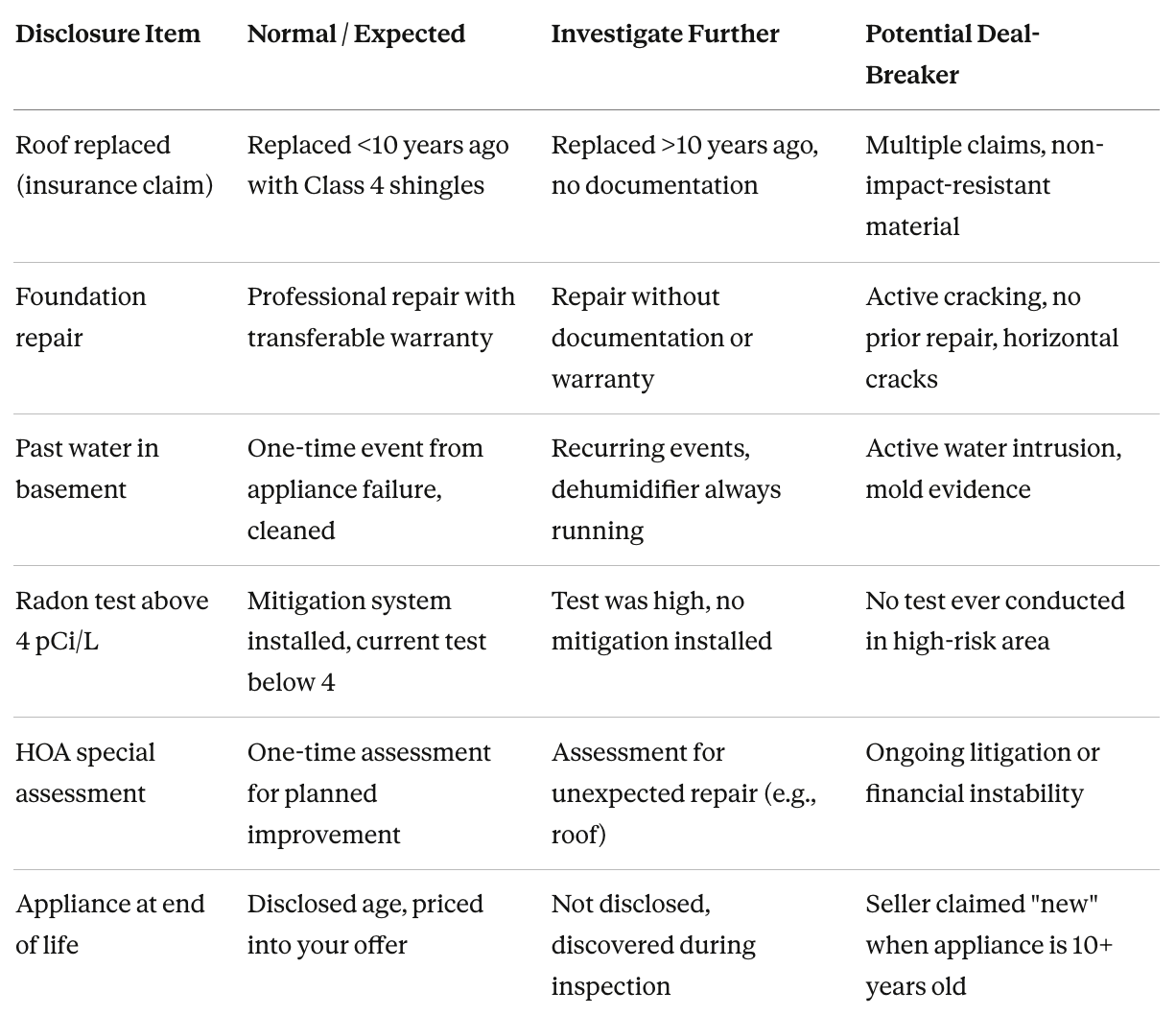
Which SPD disclosures are red flags, and which are normal?
Not every "Yes" on the SPD is a deal-breaker. Here's how to calibrate your response:
What is a Colorado seller not required to disclose?
Colorado's "current actual knowledge" standard means there are significant gaps in what the SPD covers: sellers do not have to disclose defects they don't know about.
Sellers are not required to disclose: defects they don't know about (even if "obvious" to others), neighborhood issues like noisy neighbors or nearby development plans (unless they directly affect the property), future construction projects (unless disclosed under the transportation project statute), psychological stigmas (like a death in the home — Colorado doesn't require this), or their reasons for selling.
Sellers ARE required to disclose (separate from the SPD, by state statute): whether the property is in a special taxing district, common interest community information, methamphetamine use history, water source details, proposed transportation projects affecting the property, metropolitan district website information (for districts organized after January 1, 2000), radon information, and mineral/oil/gas rights information. (Source: Colorado Revised Statutes §§ 38-35.7-101 through 38-35.7-112)
How should you use the SPD during your transaction?
Read the SPD as soon as you receive it — ideally before your inspection. Use it to create a targeted list of questions and areas for your inspector to focus on. If the seller disclosed a past foundation repair, tell your inspector to spend extra time on the foundation. If the seller noted past water intrusion, have your inspector use a moisture meter on all basement walls.
Ask follow-up questions in writing through your agent. A written question creates documentation. If the seller claims no knowledge of an issue that your inspection reveals, having asked about it in advance strengthens any future claim.
Compare the SPD to what you observe during your home tour. If you noticed sticking doors and diagonal drywall cracks but the seller checked "No" on foundation issues, that discrepancy is worth raising with your agent.
Finally, remember that the SPD is one data point — not the whole picture. Combine it with your home inspection, your agent's local knowledge, and public records (permit history, property tax records, HOA documents) to build a complete understanding of what you're buying. For a deeper look at the full buying process in Broomfield, see the Complete Guide to Buying a Home in Broomfield.
Ready to make sense of the paperwork on your next home purchase?
I review every SPD form with my clients line by line — flagging the items that need follow-up and translating real estate legalese into plain English. If you're buying in Broomfield, Anthem, or anywhere in the North Denver metro, I'll make sure nothing gets lost in the fine print.
📧 Email Nick directly: NickAhrensRealEstate@gmail.com
Search homes and next steps
Related reading
Frequently Asked Questions
What does "current actual knowledge" mean on the Colorado property disclosure?
Under Colorado law, sellers are only required to disclose defects they actually know about — not defects they "should have known" about. This means a seller who never lived in the property may legitimately have limited knowledge. However, if a seller knowingly conceals a known defect, they face legal liability for non-disclosure. The standard is subjective, which is exactly why buyers should never rely solely on the disclosure — a professional home inspection is essential regardless of how clean the SPD looks.
What changed on the 2026 Colorado Seller's Property Disclosure form?
The Colorado Real Estate Commission released the updated SPD19 with a mandatory use date of January 1, 2026. It's 14 pages long — two pages longer than its predecessor — and represents the most extensive rewrite in over two decades. Key additions include specifying gas vs. electric for appliances, expanded environmental disclosures, more detailed water supply questions, and enhanced radon disclosure requirements including test history and mitigation details. Any contract dated January 1, 2026 or later must use the new version. (Source: Colorado Real Estate Commission, August 2025)
Can I sue a seller for not disclosing a problem in Colorado?
You can pursue legal action, but the burden of proof is on you to demonstrate the seller had actual knowledge of the defect and intentionally withheld it. If you asked about a specific issue in writing and the seller misrepresented the facts, your case is significantly stronger. This is why documenting your questions and the seller's responses throughout the transaction is a smart protective strategy.
Does the seller's property disclosure replace a home inspection?
No — and the SPD form itself explicitly states this on page 14. The disclosure only covers what the seller knows, not what physically exists. A home inspection ($400-$600 in the Denver metro) provides an independent, professional evaluation of the property's condition. Combined with a radon test ($150-$200) and sewer scope ($150-$300), your total due diligence cost is under $1,100 — a small price to protect a $500,000+ investment.
Are sellers required to disclose past problems that were repaired?
Yes. The SPD form uses bold capital letters to state that sellers must disclose conditions that "EVER EXISTED" — including those that have been repaired. Past foundation work, flooding events, mold remediation, roof replacements, and sewer line repairs must all be disclosed even if the problem is fully resolved. This gives you the opportunity to evaluate whether the repair was professionally done and whether the underlying issue could recur.
Nick Ahrens is a Broomfield real estate expert with the North Denver Report, specializing in Anthem, Anthem Highlands, Baseline, and the North Denver metro.