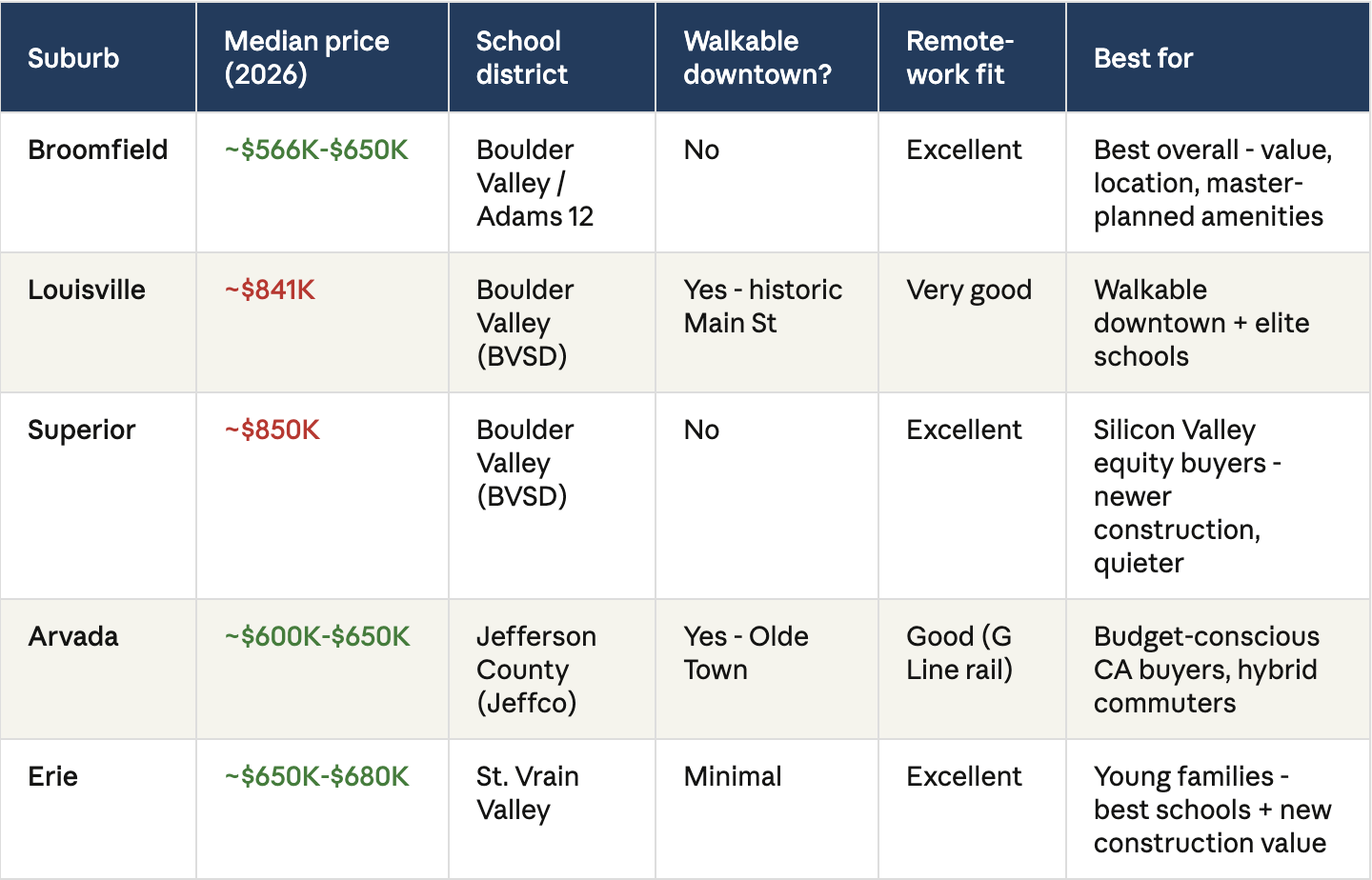
Quick answer: The best Denver suburbs for California transplants in 2026 are Broomfield, Louisville, Superior, Arvada, and Erie, in that order. Broomfield leads for most buyers, with a $566K median (Redfin, January 2026), master-planned communities like Anthem and Baseline, and a midpoint location between Denver and Boulder.
By Nick Ahrens, Colorado real estate broker license FA.100104470, eXp Realty
Last Updated: April 2026
The best Denver suburbs for California transplants are Broomfield, Louisville, Superior, Arvada, and Erie, in that order. The ranking is based on where CA buyers actually land (IRS migration data), what they're buying (median price and home type), and what they care most about (schools, remote-work infrastructure, master-planned amenities, and outdoor access). Broomfield leads because it sits exactly halfway between Denver and Boulder on the US 36 tech corridor, has three master-planned communities that mirror the California suburb experience, and draws more California households per year than any other suburb in the North Denver metro.
I help California buyers relocate to the North Denver area every week. The same five suburbs come up constantly, and the same questions follow. This post answers all of them.
Why do California buyers move to the North Denver suburbs?
California buyers come for space, good schools, and outdoor access, and they don't come to the Denver metro randomly. IRS migration data from 2021-2022 shows 144 California tax returns filed in Broomfield County alone, with an average household income of $125,764. The Santa Clara County (Silicon Valley) cohort that lands here arrives with an average household income of $214,893, often carrying hundreds of thousands in Bay Area or LA home equity.
What they're looking for is consistent: space, good schools, proximity to outdoor recreation, and a suburb that doesn't feel like a compromise. The North Denver corridor delivers on all of it. The US 36 highway runs from Denver through Broomfield, past Louisville and Superior, and into Boulder, creating a 40-mile band of communities with low crime, excellent schools, mountain views, and home prices that look modest by California standards.
One thread from r/MovingtoDenver with 60+ comments on it put it simply: "Honestly, I'd recommend anywhere in the Broomfield/Superior/Lafayette/Louisville/Erie area." That consensus is what the data shows too.
Why is Broomfield the best Denver suburb for California transplants?
Broomfield is the single most popular destination for California relocators in the North Denver corridor, and the reasons stack up fast. The city of 76,000 sits at the midpoint of the Denver-Boulder corridor, meaning a commute to either downtown Denver (about 25 minutes) or Boulder (about 20 minutes) is about the same. For the remote-working California tech worker who needs to get to a Denver office once or twice a week, that location is nearly perfect.
Median home price: $566K (Redfin, January 2026) to $647K average (Zillow). Within Broomfield, prices span a wide range. The Anthem community, Broomfield's most premium master-planned neighborhood, carries a median around $1,027,238. Anthem Highlands averages around $615K, and the newer Baseline community sits near $566K. That range means almost any California buyer with Bay Area or LA equity can find a fit here.
Master-planned communities are the big differentiator. California buyers, especially those coming from Irvine, Pleasanton, or the East Bay suburbs, recognize the master-planned format immediately: HOA-maintained common areas, resort-style rec centers, community pools, walking trails, and new construction from reputable builders. Anthem, Anthem Highlands, and Baseline all deliver this. Anthem alone has a 60,000-square-foot rec center and five pools.
The tech employer corridor matters to buyers who are not fully remote. Oracle, Vail Health System, Lumen Technologies, and Ball Aerospace all have major Broomfield offices. The city has earned a reputation as the "Silicon Flatirons" zone, distinct from Boulder but close enough to benefit from Boulder's talent pipeline.
One note that Reddit threads surface consistently: Broomfield doesn't have a walkable downtown. If a Main Street bar-and-restaurant scene is what you're after, Louisville below will fit better. Broomfield trades walkability for space, amenities, and value.
Schools: Broomfield straddles two districts. Most of the master-planned communities (Anthem, Anthem Highlands) feed into the Boulder Valley School District, which is well-regarded. The Baseline area and some southern Broomfield neighborhoods serve the Adams 12 Five Star district. Check the specific address, not just the city, when evaluating school assignments.
Best fit: Remote workers with California equity who want master-planned amenities, maximum value per square foot, and easy access to both Denver and Boulder. Also the top pick for families prioritizing space over walkability.
Learn more:The Broomfield Relocation Guide | Anthem vs Anthem Highlands vs Baseline: The Definitive Comparison
Is Louisville the best Denver suburb for a walkable downtown?
Louisville consistently ranks among the most livable small cities in the country, and for a specific type of California transplant, it's the strongest match. Think: Berkeley or Santa Cruz energy, a walkable Main Street lined with independent restaurants and coffee shops, a genuine local community, and some of the best schools in the state.
Median home price: $841K (Redfin, February 2026). That's a jump from Broomfield and reflects Louisville's Boulder County location and the premium that walkability and school quality command. For Bay Area buyers trading a $1.4M San Jose home for a $900K Louisville home, the math still works. For the LA buyer at $850K, Louisville is roughly apples-to-apples on price but with dramatically more space and lower taxes.
Louisville's Main Street is the thing that makes California buyers stop scrolling. Unlike most Denver suburbs, Louisville has an actual historic downtown with locally owned restaurants, a farmers market, an ice rink in winter, and a community feel that doesn't require driving to experience. For buyers coming from walkable CA neighborhoods, this is a significant quality-of-life upgrade over a sprawling suburban grid.
Schools are Louisville's strongest card. The Boulder Valley School District serves the city, with Louisville Elementary, Louisville Middle School, and Monarch High School (rated 9/10 on GreatSchools) all drawing strong marks. Families with school-age kids who want the best public education outcome in the corridor should put Louisville near the top.
The Marshall Fire consideration: Louisville was significantly affected by the December 2021 Marshall Fire, Colorado's most destructive wildland fire in terms of homes destroyed. Many homes in the affected areas have been rebuilt. Before buying in Louisville, buyers should understand the wildfire risk profile of specific neighborhoods and budget accordingly for homeowners insurance. Reddit threads about Louisville consistently surface this question, and it's worth a direct conversation with any agent you work with.
Best fit: Buyers coming from Berkeley, Santa Cruz, Brentwood, or any CA city with a walkable downtown they love and don't want to give up. Also a strong pick for families who are unwilling to compromise on schools.
Is Superior a good fit for Silicon Valley buyers with big equity?
Yes, especially for buyers who want newer construction and Boulder Valley schools. Superior is a smaller town, around 14,000 residents, that gets passed over by buyers who don't know it. Those who do know it tend to love it. Sitting just north of Louisville and southeast of Boulder, Superior combines master-planned subdivision density with Boulder County schools and mountain views that rival anything in the Denver metro.
Median home price: $850K (Redfin, January 2026). Superior prices have risen sharply, up 11.9% year-over-year in early 2026. That appreciation rate is being driven by limited inventory and strong demand from exactly the buyer profile that reads this post. For Silicon Valley buyers arriving with $600K-$1M in equity, Superior offers newer construction, a quieter community, and immediate access to the Flatirons trail system.
Boulder Valley School District serves Superior, which means the same school quality as Louisville at a similar price point. Families who want the BVSD advantage but find Louisville's downtown premiums too steep often land in Superior.
The master-planned feel in Superior's Rock Creek and Autrey Shores neighborhoods will feel familiar to California buyers. Well-maintained streets, HOA-managed common areas, and a clean, planned suburban grid. Superior also benefits from its proximity to the Flatirons Open Space and direct trail access to the Southern Walden Ponds, giving outdoors-oriented CA buyers the trail access they moved here for.
Best fit: Silicon Valley buyers with maximum equity who want brand-new or newer construction, Boulder County schools, and mountain proximity without paying Boulder prices. Also a strong pick for buyers who want quiet and don't need a downtown scene.
Is Arvada the best value Denver suburb for California transplants?
Yes. At around $600K-$650K, Arvada is one of the more affordable picks here, and it is the suburb that surprises California buyers the most. With a population of 121,000, it's larger than most people expect, has its own charming historic district (Olde Town Arvada), and sits just northwest of Denver with direct light rail access to Union Station via the RTD G Line.
Median home price: Around $600K-$650K (Redfin September 2025 / Movoto). Arvada is described consistently in Reddit threads as "one of the least expensive suburbs on the northwest side," which makes it a natural target for California buyers whose equity doesn't quite reach Louisville or Superior price points, or who simply don't want to stretch.
Olde Town Arvada gives the city something most northwest suburbs lack: a pedestrian-friendly historic core. Closed sections of Olde Wadsworth Boulevard mean strolling to dinner, coffee, or a brewery without getting in a car. For CA buyers who want some walkability without the Louisville price premium, Arvada delivers a solid version.
The G Line light rail is a significant advantage for hybrid workers. A direct shot from Olde Town Arvada to Denver's Union Station runs in roughly 30 minutes without touching a highway. For California transplants used to Bay Area commuter rail, this infrastructure feels familiar.
Schools in Arvada fall under the Jefferson County (Jeffco) district, the largest in Colorado with 85,000 students. School quality in Jeffco varies significantly by neighborhood. West Arvada, which includes neighborhoods like Leyden Ranch and West Woods, feeds into some of Jeffco's strongest schools and is where most California family buyers settle.
Best fit: California buyers who want to maximize square footage and value, prefer a more urban-adjacent feel, or are commuting to Denver on a hybrid schedule. Also the best pick for buyers coming from more affordable CA markets (Inland Empire, Sacramento) who still want the Colorado lifestyle without stretching their budget.
Is Erie a good Denver suburb for young California families?
Yes. Erie doesn't come up as often in relocation searches, but it should. This fast-growing community of 37,000 on the Boulder-Weld County line is the newest and most affordable option in the North Denver corridor for families who want the best possible combination of price and school quality.
Median home price: Around $650K-$680K. Erie's newer inventory tends to offer more square footage per dollar than its western neighbors, making it a smart play for families with kids who need space.
St. Vrain Valley School District is the reason Erie gets serious attention from families. Reddit threads about Erie schools are consistently enthusiastic. One r/MovingtoDenver commenter put it directly: "St. Vrain Valley school district is honestly excellent. I've never seen an area care so deeply about their public school district." Families who've done their school research know that St. Vrain Valley competes with BVSD for the top spot in the corridor.
The newer construction factor is significant. Erie has seen more new home development in the last five years than almost any suburb in the metro. The Colliers Hill, Vista Ridge, and Flatiron Meadows communities offer buyers California-style master-planned layouts with new home warranties, energy-efficient construction, and builder incentives that exist nowhere on the US 36 corridor.
One honest trade-off: Erie is further from Denver and Boulder than the other suburbs on this list. A Denver commute is 30-40 minutes. Boulder is 20-25 minutes. For buyers who are fully remote, this doesn't matter at all. For hybrid workers with regular office requirements, it's worth running the commute math before committing.
Best fit: Young California families with kids who want maximum square footage, the best school district in the corridor, and brand-new construction at a lower price point than Louisville or Superior.
How do you choose the right Denver suburb as a California transplant?
After working with dozens of California transplants, I've found that one question typically sorts the choice:
Are you buying lifestyle, or buying value?
Buyers buying lifestyle, meaning they want the walkable downtown, the specific school district, the mountain proximity, typically end up in Louisville or Superior and pay for it. Buyers buying value, meaning they want maximum space and amenity for their equity, typically end up in Broomfield or Arvada. Erie is the answer for families who want both (school quality plus new construction value) and don't mind the slightly longer commute.
Most California buyers with significant equity end up in Broomfield because it covers the most ground: reasonable value, master-planned amenities, excellent location, and three distinct community options (Anthem, Anthem Highlands, Baseline) that let buyers match price to budget within the same city.
Ready to Figure Out Which Suburb Actually Fits You?
I do this every week with California buyers. We run the equity math, map the commute, and I show you the specific neighborhoods in each suburb that match your priorities. Skip the Zillow rabbit hole and email me directly.
📧 Email Nick:NickAhrensRealestate@gmail.com 🏠 Browse listings:zillow.com/profile/NickAhrensRealEstate
Search homes and plan your move
Related comparisons
Frequently Asked Questions
Which Denver suburb is best for California transplants? Broomfield is the top choice for most California transplants because it sits halfway between Denver and Boulder, has three master-planned communities (Anthem, Anthem Highlands, Baseline) that mirror the CA suburb experience, and has the highest concentration of remote-friendly tech employers on the US 36 corridor. IRS migration data shows 144 California households moved to Broomfield in a single year.
Is Broomfield a good place for California transplants? Yes. Broomfield's master-planned communities, tech employer base, and midpoint location between Denver and Boulder make it the default landing spot for California relocators in the North Denver metro. Home prices range from $566K to $1M+ depending on the neighborhood, which gives CA buyers with varying equity levels a real choice.
Is Louisville or Broomfield better for California families? It depends on priorities. Louisville has the best walkable downtown and the highest-rated schools in the corridor, but carries a median price of $841K (February 2026). Broomfield offers more value per square foot ($566K-$650K median) and master-planned amenities. Families prioritizing school prestige and walkability pay the Louisville premium. Families prioritizing space and value choose Broomfield.
What is the best suburb near Denver for remote workers from California? Broomfield and Superior lead for remote workers. Both sit on the US 36 corridor with easy access to Denver or Boulder for occasional office days. Broomfield's Anthem community has one of the highest work-from-home rates in the state (54.8% of residents). Both cities have reliable fiber internet and coffee shop infrastructure built around remote work.
How do Denver suburb home prices compare to California? The median home price in Broomfield is approximately $566K-$650K (2026). The San Francisco Bay Area median sits around $1.3M and the LA metro around $900K. Most California buyers arrive with enough equity to buy in Broomfield at or near all-cash, or to carry a mortgage dramatically smaller than what they had in California, even at current interest rates.
Source notes: Home prices sourced from Redfin and Zillow (January-February 2026). Migration data from IRS Statistics of Income, 2021-2022. School ratings from GreatSchools.org. Income data from IRS county migration files.
Nick Ahrens is a Broomfield real estate expert with the North Denver Report, specializing in Anthem, Anthem Highlands, Baseline, and the North Denver metro.