Broomfield vs. Arvada vs. Lakewood: Which Denver Suburb Is Actually Right for You?
Quick answer: The right Denver suburb depends on lifestyle, because Broomfield, Arvada, and Lakewood sit within about $75,000 of each other in median home price. Broomfield fits master-planned amenities and Denver-Boulder commutes, Arvada fits Olde Town walkability and G Line rail, and Lakewood fits the lowest price point and foothills trails.
By Nick Ahrens, Colorado real estate broker license FA.100104470, eXp Realty
Which is better: Broomfield, Arvada, or Lakewood?
Lifestyle picks the winner, not price: Broomfield, Arvada, and Lakewood sit within about $75,000 of each other in median home price. Budget rarely picks the winner. Lifestyle does.
Watch the video: Broomfield vs Arvada vs Lakewood: An Honest 2026 Comparison
Where each wins:
Broomfield – master-planned amenities and the Denver-Boulder corridor
Arvada – historic Olde Town, G Line light rail to Union Station, urban-adjacent energy
Lakewood – lowest price point of the three, foothills trail access near the back door, and often the shortest drive to downtown Denver
I tour buyers across these three every month. This page is the written companion to the YouTube breakdown: 2026 medians, commute realities, and a Tuesday-night sorter so you can decide which suburb is actually right for you.
This post does NOT cover: Boulder/Louisville/Superior premiums, or the Anthem vs Highlands vs Baseline micro-comparison inside Broomfield.
Last updated: September 2026 | Nick Ahrens, Broomfield broker, North Denver Report
How do Broomfield, Arvada, and Lakewood home prices and commutes compare?
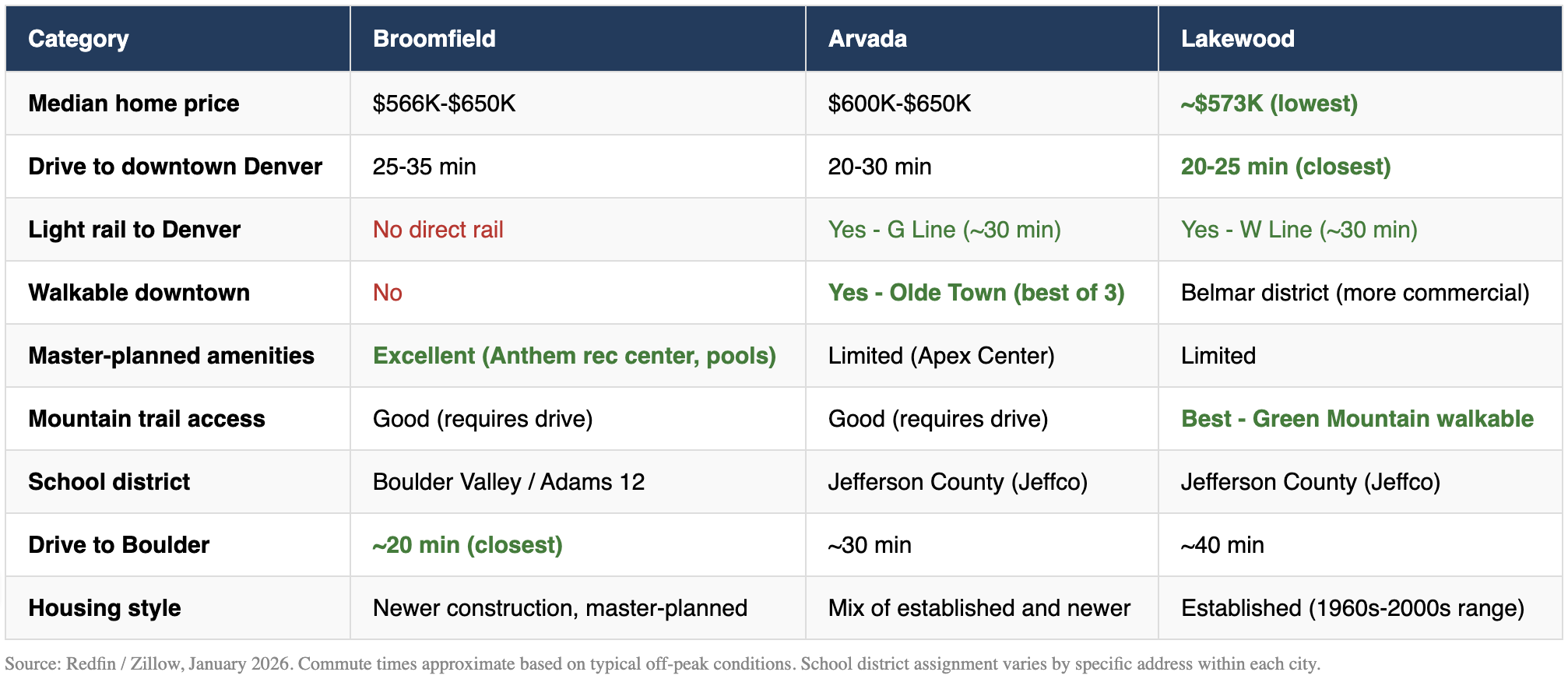
All three land between roughly $566K and $650K at the median, with 20-35 minute off-peak car commutes to downtown Denver. The side-by-side:
Median home (approx.) - Broomfield: $566K-$650K (Redfin Jan 2026 / Zillow band) - Arvada: ~$600K-$650K (Redfin Sep 2025 window) - Lakewood: ~$573K-$575K (Redfin Jan 2026 / Zillow)
Denver car commute - Broomfield: 25-35 min (I-25 / US-36) - Arvada: 20-30 min - Lakewood: 20-30 min (often shortest)
Rail to Union Station - Broomfield: No direct light rail (US-36 Flyer / Park-n-Ride) - Arvada: G Line ~30 min - Lakewood: W Line under ~30 min from corridor stops
Boulder access - Broomfield: Strong (~20 min) - Arvada: Moderate - Lakewood: Weaker than Broomfield
Downtown walkability - Broomfield: Weak (corridor retail) - Arvada: Strong (Olde Town) - Lakewood: Moderate (Belmar = commercial center)
Signature outdoor - Broomfield: In-plan trails / rec centers - Arvada: Solid, usually a drive - Lakewood: Green Mountain 2,400 acres / 18 trail miles
School districts - Broomfield: BVSD (north MPCs), Adams 12, Jeffco pockets - Arvada: Jeffco - Lakewood: Jeffco
Typical HOA posture - Broomfield: Higher in MPCs ($150-$350/mo common) - Arvada: Mixed / often lower - Lakewood: Mixed
All three sit roughly 20-35 minutes from downtown Denver off-peak. Details decide the next decade.
Why choose Broomfield over Arvada or Lakewood?
Choose Broomfield for master-planned living on the Denver-Boulder corridor. Broomfield was largely built over the last ~30 years with planned infrastructure, rec centers, open-space easements, and trail networks. If a listing looks “almost too clean,” that is intentional.
Price pockets: Anthem median near $1,027,238; Anthem Highlands nearer ~$615K on longer windows; Baseline near ~$566K. Different budgets can still land in Broomfield – in different pockets.
Location: Midpoint of US-36 between Denver (~25 min) and Boulder (~20 min). Dual-income Denver+Boulder households rarely find a cleaner geometry.
Amenities: Anthem’s rec center is about 60,000 sq ft with pools, tennis, fitness, and kids’ programming. Highlands has Parkside Center + trails. Baseline is newer and denser inside the plan. You pay HOA for that stack; many relocators treat it as bundled gym/pool membership.
What Broomfield lacks: A walkable downtown. Friday dinner usually means a car. That is the most common reason buyers choose Arvada after touring both.
Best fit: Amenity-rich lifestyle, newer construction, Denver+Boulder access, families who want trails/rec built into the neighborhood.
Why choose Arvada over Broomfield or Lakewood?
Choose Arvada for a historic downtown and G Line rail. Arvada (~121,000 residents) surprises name-only shoppers. Olde Town has pedestrian-closed streets, breweries, local restaurants, and a neighborhood feel Broomfield does not replicate.
Price: ~$600K-$650K median band. Dollars more often buy established character, mature trees, and larger lots instead of new-build HOA amenity packages.
Olde Town differentiator: Closed sections of Olde Wadsworth / Grandview, Arvada Center for the Arts, walkable dining. If the question is “which northwest suburb has a real downtown?” – Arvada answers it.
G Line: Olde Town to Union Station in about 30 minutes without I-25. Biggest practical edge over Broomfield for hybrid Denver office days.
West Arvada: Leyden Ranch, West Woods, Candelas – larger lots, stronger Jeffco reputations in many pockets, closest geographically to Broomfield (same-day dual tours are common).
Best fit: Walkable historic core, light rail, established character; hybrid workers; families targeting West Arvada school assignments.
Why choose Lakewood over Broomfield or Arvada?
Choose Lakewood for the lowest median of the three and foothills access. Lakewood (~168,000) is the largest of the three and the most variable. Inventory runs from older central bungalows/split-levels to newer Green Mountain and Solterra product on the western edge.
Price: ~$573K-$575K median – lowest of the trio in the cited 2026 windows. Belmar, Solterra, and Green Mountain print higher; central/east skew older and more affordable.
Green Mountain: William Frederick Hayden Park covers 2,400 acres with 18 miles of trails. Only suburb in this set where “change shoes, hit dirt” is a realistic Tuesday plan.
Belmar: Outdoor retail/dining – more commercial center than historic downtown, but functional for errands and dinner without driving into Denver.
W Line: Light rail parity with Arvada for neighborhoods near the line; Belmar / Sheridan-area riders can reach Union Station in under ~30 minutes.
Honest trade-off: Neighborhood feel varies more than in Broomfield or even Arvada. Research the address, not the city sticker.
Best fit: Lowest entry of the three, shortest Denver drive, foothills access, buyers who do not need master-planned amenity packages.
What are the watch-outs in Broomfield, Arvada, and Lakewood?
Medians hide pocket premiums – Anthem, Candelas, Solterra, and Belmar-adjacent inventory do not behave like citywide medians.
HOA + metro district – especially Broomfield MPCs; underwrite both.
Rail vs bus – Broomfield is Flyer/Park-n-Ride, not G/W Line.
School assignment – Jeffco quality is neighborhood-specific. BVSD applies only to some Broomfield addresses. Verify at the address level.
Tuesday-night test beats brochure amenities – see sorter below.
Which suburb is actually right for you? Try the Tuesday-night test
What do you want to do on a Tuesday evening after work?
Walk to dinner / brewery without a car – Go to Arvada (Olde Town). Why: pedestrian core + G Line.
Rec center / neighborhood trail with kids – Go to Broomfield (Anthem / Highlands / Baseline). Why: bundled amenities.
Change shoes and get on a trail – Go to Lakewood (Green Mountain / west side). Why: Hayden Park access.
Touch Boulder tomorrow morning – Go to Broomfield. Why: US-36 geometry.
Skip HOA theater, buy trees + lot – Go to Arvada (often) or non-MPC Broomfield. Why: product mix.
Maximize sq ft per dollar near Denver – Go to Lakewood (pocket-dependent). Why: lowest median band.
All three are established Front Range suburbs with workable Denver access. At these price bands the decision is almost never “which is cheapest on paper.” It is how you spend Tuesday.
Relocator note (CA / TX / IL)
If you are comparing these three on one trip: start with Broomfield for Anthem-style planned living, Arvada if you miss a real downtown and rail, west Lakewood if outdoors-first. I run that exact three-stop day regularly.
Ready to tour all three in a single day?
Email priorities (budget, rail vs car, Boulder need, HOA tolerance). I map specific pockets – not three city welcome signs.
Email: NickAhrensRealestate@gmail.com
Text: 949-230-3625
Browse: https://www.zillow.com/profile/NickAhrensRealEstate
Search homes and compare areas
Related comparisons
Frequently Asked Questions
Is Broomfield or Arvada better to live in?
Depends on priorities. Broomfield wins for master-planned amenities, newer construction, and Denver-Boulder corridor access. Arvada wins for walkable historic downtown, G Line, and established character. Both sit near the $600K-$650K median band in 2026 windows, so lifestyle – not budget – usually decides.
Is Lakewood a good suburb of Denver?
Yes for the right pocket. Median ~$573K-$575K (Jan 2026 citations) is the lowest of this trio, with the shortest car commute to downtown, W Line access, and Green Mountain trail access on the west side. Neighborhood quality varies – be address-specific.
What is the commute from Broomfield to Denver?
About 25-35 minutes by car via I-25 or US-36 depending on traffic. RTD US-36 Flyer is available. No Broomfield light-rail station. Arvada G Line and Lakewood W Line are stronger car-free options.
Which suburb is best for families?
All three can work. Broomfield MPCs offer the strongest built-in amenity packages. West Arvada feeds many of Jeffco’s stronger campuses by reputation. Lakewood’s Green Mountain area pairs outdoor access with solid west-side schools. Always verify school assignment for the exact address.
How do schools compare across all three?
North Broomfield MPCs often use Boulder Valley. Much of southern Broomfield, plus all of Arvada and Lakewood, sit in Jeffco. Jeffco quality varies widely by neighborhood – research the elementary assignment before you write.
Source notes: Home prices from Redfin and Zillow windows cited above (2025-2026). Commute times are off-peak approximations. School data should be confirmed on district assignment tools / GreatSchools for the address.
Nick Ahrens is a Broomfield real estate broker with the North Denver Report, specializing in Anthem, Anthem Highlands, Baseline, and the North Denver metro.