California vs. Colorado Property Tax: The Real 2026 Comparison for Relocators
Last Updated: April 2026
Colorado has a lower effective property tax rate than California, but the comparison that actually matters for relocators is the dollar amount you'll pay each year on the home you actually buy. For a household selling a $900,000 California home and buying a $600,000 Broomfield home, annual property tax typically drops from around $10,890 to around $2,940, a savings of roughly $7,950 per year. That's before you factor in Colorado's lower income tax, which for high earners often adds another $8,000 to $15,000 in annual savings.
California's median effective property tax rate is 1.21% in 2026 according to Ownwell, while Colorado's statewide effective rate sits near 0.49%. A $900,000 California home generates approximately $10,890 in annual property tax. A $600,000 home in Broomfield, Colorado, generates approximately $2,940 in base property tax. Broomfield sits 30 minutes from downtown Denver and 20 minutes from Boulder.
I've walked California buyers through this exact math on dozens of relocations. The surprise is always the same: the tax story Californians tell themselves about "leaving the high-tax state" usually understates the savings by half.
How California Property Tax Actually Works in 2026
Most Californians think their property tax is 1%. That's the Proposition 13 base rate, and it's technically accurate, but it's also misleading. The real effective rate for new California buyers in 2026 is 1.15% to 1.35% in most ZIPs once you add local school bonds, infrastructure measures, and wildfire mitigation fees.
New buyers get hit hardest. Prop 13 caps annual increases at 2% once you own the home, but when you purchase, the property is reassessed at full market value. You lock in today's high valuation for the next 30 years.
If you bought in a Mello-Roos Community Facilities District, add another 0.15% to 0.55% on top. That's common in Irvine, Chula Vista, parts of Riverside County, and most newer Sacramento subdivisions. On a $1 million Irvine home, Mello-Roos alone can add $5,500 per year to your bill.
California's median property tax bill is $5,134 per year according to Ownwell, but in high-cost counties the number is far higher. Orange County median is $6,436. Palo Alto median tops $23,000.
How Colorado Property Tax Works (And Why It's So Different)
Colorado uses a three-step calculation that confuses first-time Colorado buyers. The state sets an assessment rate (6.7% for residential in 2026), the county assessor determines your home's actual value, and the local mill levy is applied to the assessed value.
A $600,000 Broomfield home at a typical 85 mill levy looks like this: $600,000 × 6.7% assessment rate = $40,200 assessed value. $40,200 × 0.085 mill levy = $3,417 per year in base property tax.
The 6.7% assessment rate is what makes Colorado look like a tax haven compared to California, where you're taxed on 100% of market value. Colorado is effectively taxing you on less than 7% of your home's value before the mill levy is applied.
The catch is the metro district system. Master-planned communities in Broomfield like Anthem, Anthem Highlands, and Baseline often have additional metro district mill levies of 30 to 75 mills on top of the base rate. That can push your effective property tax rate from 0.49% to 0.85% or higher.
The Real California to Broomfield Tax Comparison
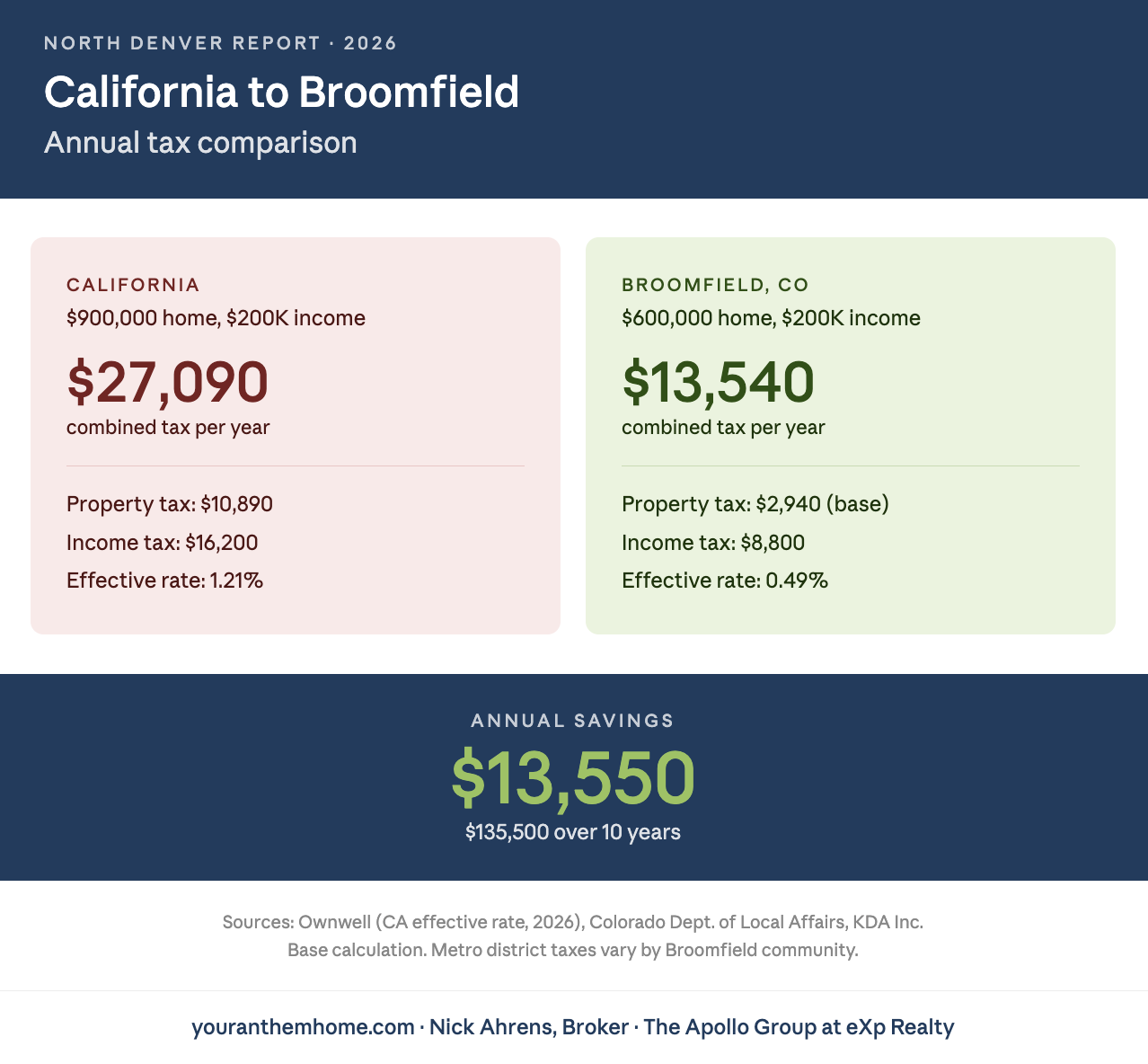
Here's what relocators actually pay, using realistic 2026 numbers for a mid-tier California home vs. a typical Broomfield home.
Over 10 years, the combined tax savings for this household is $135,500 to $153,500. That's not a trivial number, and it doesn't include the appreciation differential between a $900,000 California asset and a $600,000 Colorado asset.
What to Watch Out For When Buying in Broomfield
The Colorado tax advantage is real, but there's one trap California buyers fall into: assuming every Broomfield home has the same property tax profile. It doesn't.
Homes inside metro districts pay meaningfully more than homes outside them. In Broomfield, the three largest master-planned communities, Anthem, Anthem Highlands, and Baseline, all have metro district taxes. These can add $1,800 to $4,500 per year to your base property tax bill depending on the specific district and when the home was built.
Before you make an offer on any Broomfield home, ask the listing agent for the current year's tax bill and the metro district mill levy breakdown. If the tax bill is significantly higher than similar-priced homes in Broomfield, the difference is almost always the metro district. That's not a deal killer. Metro districts fund the amenities these communities are known for, pools, parks, trails, clubhouses. But you need to budget for it correctly.
For a full breakdown of how Broomfield metro districts work and which communities have them, you can email me directly at NickAhrensRealestate@gmail.com and I'll send you the specific numbers for the homes you're looking at.
The Prop 13 Trap (And Why It Matters for California Sellers)
Here's what most California sellers don't realize when they're on the fence about relocating: the longer you wait, the less valuable your Prop 13 advantage becomes in a relative sense.
If you bought your California home 20 years ago for $400,000 and it's now worth $1.8 million, your property tax bill is probably around $5,200 a year (based on your locked-in 2004 assessment plus 2% annual increases). A new buyer of that same home would pay over $21,000 a year. Your Prop 13 protection is worth roughly $16,000 annually.
But when you sell and buy in Colorado, you cash out $1.4 million in tax-protected equity and buy a Broomfield home that's already at a lower cost basis and lower effective tax rate. You lose the Prop 13 shield but gain a bigger asset cushion and lower ongoing costs. For most 50-plus California homeowners with substantial equity, the math strongly favors moving.
The one group this doesn't apply to: California homeowners with a Prop 13 basis below $300,000 who plan to stay 20+ more years and don't care about liquidity. If that's you, stay.
How to Calculate Your Own Relocation Tax Savings
You don't need a spreadsheet wizard to run your numbers. Here's the three-line version:
California property tax bill (current annual amount)
Colorado estimated property tax bill: (Colorado home price × 0.0067 × your mill levy, or just use 0.005 if you don't know the mill levy yet)
Income tax differential: (CA income tax owed) - (Colorado flat 4.4% tax)
Add lines 1 and 3 together, subtract line 2. That's your first-year savings.
For anyone seriously considering the move, I can run a custom comparison with your actual California ZIP, current property tax bill, and target Broomfield price range. Text me at 949-230-3625 or email NickAhrensRealestate@gmail.com with those three data points and I'll send back real numbers within 24 hours.
Disclaimer: I am not a licensed CPA. This article is merely for general information purposes and should not be used as something that is accurate. I advise everyone to contact a CPA for actual numbers, actual taxes and actual financial figures for you and your family.
Ready to Run Your Numbers?
I help California relocators every month work through this math before they commit to a move. If you want the specific Broomfield tax numbers for your situation, or want to browse homes in the 80023 metro district communities where the biggest CA-to-CO tax swings happen, reach out.
📱 Text Nick: 949-230-3625
📧 Email Nick: NickAhrensRealestate@gmail.com
🏠 Browse Broomfield homes: https://www.youranthemhome.com/home-search
⭐ Check my reviews: https://www.zillow.com/profile/NickAhrensRealEstate
Nick Ahrens is a Broomfield real estate expert with eXp Realty (CO Broker License FA100104470), specializing in Anthem, Anthem Highlands, Baseline, and the North Denver metro. 350+ closings and $300M+ in career volume since 2011.
Frequently Asked Questions
Are property taxes higher in California or Colorado? Colorado has a lower effective property tax rate. California's median effective rate is 1.21% in 2026 while Colorado's is approximately 0.49%. For a relocator comparing a $900,000 California home to a $600,000 Broomfield home, the California owner typically pays around $10,890 per year while the Broomfield owner pays approximately $2,940 per year before metro district taxes.
What is the effective property tax rate in Broomfield, Colorado? Broomfield's base effective property tax rate is approximately 0.49%, in line with the Colorado state average. Homes inside metro districts, including parts of Anthem, Anthem Highlands, and Baseline, can see effective rates climb to 0.85% to 1.25% once metro district taxes are added.
What is Mello-Roos and does Colorado have anything similar? Mello-Roos is California's Community Facilities District tax, common in newer subdivisions. It can add 0.15% to 0.55% to your effective rate. Colorado's equivalent is the metro district system, common in master-planned communities like Anthem and Baseline. Metro district taxes typically add 0.30% to 0.75% to a base property tax bill.
Does Colorado's lower property tax offset California's income tax advantage? Colorado has a 4.4% flat income tax while California's top rate is 13.3%. For a household earning $200,000 moving from a $900,000 California home to a $600,000 Broomfield home, the combined annual savings on income tax plus property tax typically exceeds $15,000 per year.
How are property taxes calculated in Colorado? Colorado property taxes are calculated using the assessment rate (6.7% for residential in 2026) multiplied by the home's actual value, then multiplied by the total mill levy. A $600,000 Broomfield home with a typical 85 mill levy produces a tax bill of approximately $3,417 per year. Metro district taxes are added on top.
Related reading