Texas to Colorado Property Tax Reality Check: The 2026 Math Most Relocators Miss
Quick answer: Texas has the 6th-highest effective property tax rate in the U.S. at 1.60%, while Broomfield County, Colorado's median effective rate is 0.55%, about $6,300 a year less on a $600,000 home. After Colorado's 4.4% income tax, total tax burden for most Dallas or Austin relocators usually lands within a few thousand dollars.
By Nick Ahrens, Colorado real estate broker license FA.100104470, eXp Realty
Last Updated: April 2026
Texas has no state income tax. That's the headline every Texas relocator has burned into their brain. Then they see the Colorado property tax rate, panic, and tell me "taxes are way cheaper in Texas." The math says otherwise. For a family moving from the Dallas or Austin suburbs to Broomfield, the swap from a 1.60% property tax state to a 0.55% property tax county almost always wins, even after Colorado's 4.4% income tax.
According to the Tax Foundation and Texas Comptroller data, Texas has the 6th-highest effective property tax rate in the country at 1.60%, while Ownwell reports Broomfield County, Colorado at a median effective rate of 0.55%. The City and County of Broomfield mill levy of 28.969 has not been raised since 2001. On a $600,000 home, that rate gap saves a Broomfield homeowner roughly $6,300 per year compared to the same home in a Collin County or Williamson County suburb.
Is Broomfield cheaper than a Dallas suburb once you add Colorado income tax?
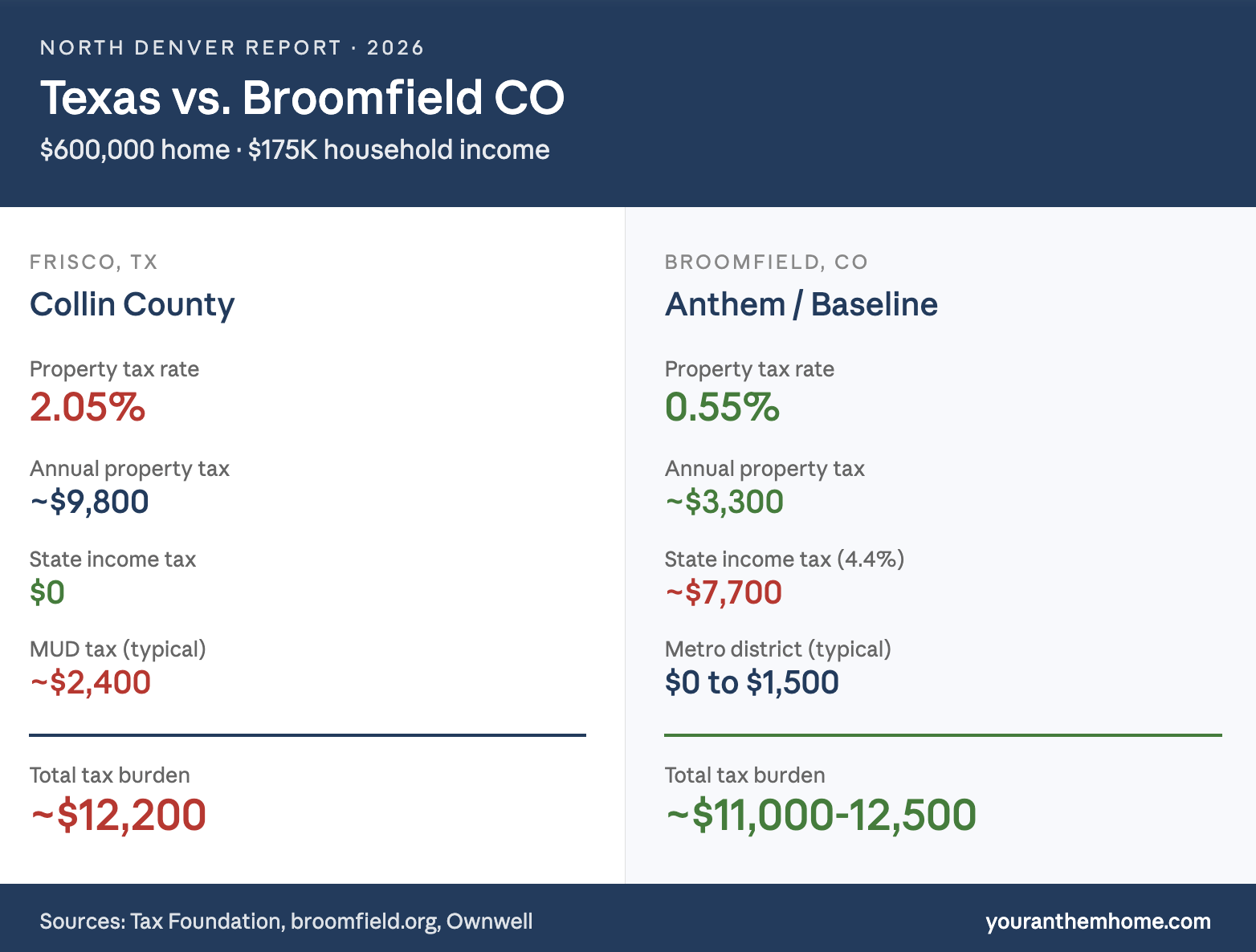
Not always: in this example, Broomfield comes out about $1,200 a year higher on paper. Let's run actual numbers on a household earning $175,000 buying a $600,000 home. In Frisco (Collin County, Texas), the effective property tax rate runs about 2.05% per Country Tax Calc's 2026 guide. That's $12,300/year in property tax, minus the $140,000 homestead exemption applied to the school portion, for a net bill around $9,800. State income tax: $0. Total state and local tax burden: roughly $9,800.
Same family in Broomfield buys a $600,000 home. Effective property tax at 0.55% is $3,300/year. Colorado state income tax on $175,000 at 4.4% is about $7,700. Total state and local tax burden: roughly $11,000. Yes, Colorado is about $1,200 higher on paper, but you get mountain access, no MUD surprises, and a property tax that won't climb with rapid suburban growth the way Texas rates do.
What are Texas MUD taxes, and does Broomfield have anything similar?
Texas MUD taxes are where the Texas math gets ugly. Municipal Utility Districts in Texas add a separate layer of tax on top of county, city, and school rates. Austin-area MUDs can add $0.30 to $0.80 per $100 of valuation. On a $500,000 home, a mid-range MUD of $0.60 per $100 adds about $3,000/year on top of everything else. Communities in Leander, Hutto, Georgetown, and Kyle are packed with them.
Broomfield has metro district taxes in newer neighborhoods like parts of Anthem Highlands and Baseline, but they typically run a fraction of Texas MUD levels and sunset over time as bonds are paid off. When I run a full tax breakdown for Texas clients, the MUD line is usually what tips the scales in Colorado's favor by several thousand dollars annually.
Why is Broomfield's property tax rate only 0.55%?
Broomfield County's mill levy structure is unusually stable for a growing Denver metro suburb. Per broomfield.org's 2026 Property Tax 101 page, the city and county portion has held at 28.969 mills since 2001. School district mill levies (Adams 12 or Boulder Valley depending on your address) and North Metro Fire add the rest, landing most Broomfield homeowners at an effective rate between 0.50% and 0.65% of market value.
Colorado's 2025 residential assessment rate is 7.05% for school portions and 6.25% for non-school portions. That means you're only taxed on about 6-7% of your home's market value, not the full amount. Texas, by contrast, taxes the full assessed market value minus only the homestead exemption. This structural difference is why Texas rates sound lower per dollar but end up higher per home.
How do taxes compare on a $600K home in Texas vs Colorado?
On a $600,000 home, Broomfield's 0.55% effective rate works out to about $3,300 a year in property tax. The side-by-side below shows the same family in both states.
When does Colorado beat Texas on total tax burden?
Colorado wins for higher-income households buying higher-priced homes, and for retirees and lower-income households. Those are the two scenarios where Broomfield blows Texas out of the water on total tax burden. First: higher-income households buying higher-priced homes. The Texas 2.0%+ rate scales with every dollar of home value, while Colorado's income tax is flat at 4.4% regardless of home size. A $900,000 home in Frisco runs $18,450/year in property tax. The same home in Broomfield runs $4,950. That's a $13,500 annual swing that dwarfs the income tax difference.
Second: retirees and lower-income households. If you're not generating much W-2 income, Colorado's 4.4% hits almost nothing, but Texas property tax hits the full value of your home every year regardless of income. This is why I see so many Texas retirees calling me about Anthem. Property tax predictability matters more than income tax when the income side is small.
Ready to Run Your Actual Numbers?
I've done this math for dozens of Texas families relocating to Broomfield, Anthem, and Baseline. Send me your current Texas tax bill and target price range and I'll build you a side-by-side in under 24 hours. No pressure, no pitch.
Work with me:
📱 Text Nick: 949-230-3625
📧 Email: NickAhrensRealestate@gmail.com
🏠 Browse Broomfield homes: youranthemhome.com/home-search
⭐ Check my reviews: zillow.com/profile/NickAhrensRealEstate
For deeper relocation context, see my Broomfield community and relocation guides, current Broomfield market insights, or meet me here.
Search homes and plan your move
Related reading
Frequently Asked Questions
Are property taxes higher in Texas or Colorado?
Significantly higher in Texas. Texas has a 1.60% average effective rate versus Broomfield County's 0.55%. On a $600,000 home, that's about $6,300 more per year in Texas before factoring in MUD taxes.
Does Colorado's state income tax cancel the property tax savings?
For most relocators from Dallas or Austin suburbs, no. Total tax burden is usually within a few thousand dollars, and Colorado often wins for households earning under $175,000 or buying homes over $700,000.
What is the property tax rate in Broomfield, Colorado?
Broomfield County's median effective rate is 0.55%. The city and county mill levy is 28.969 and hasn't been raised since 2001.
Do Texas MUD taxes add to the property tax burden?
Yes, and it's a common surprise. Austin-area MUDs add $0.30 to $0.80 per $100 of valuation. On a $500,000 home, that's up to $4,000/year on top of standard property tax.
Is Broomfield a good place to relocate from Texas?
It's one of the top landing spots. Broomfield sits between Denver and Boulder with top-rated schools, lower property taxes than DFW or Austin, master-planned communities like Anthem and Baseline, and a climate that's the #1 reason most Texans give for leaving.