Dallas, Austin, Houston vs Broomfield: The Texas-to-Colorado Property Tax Comparison Every Relocator Needs (2026)
Last Updated: April 2026
If you own an $850,000 home in Dallas, Austin, or Houston, you are paying between $14,600 and $18,700 per year in property tax. The same home in Broomfield, Colorado costs about $4,675 per year. That gap, roughly $10,000 to $14,000 annually, is the single most overlooked number in every Texas-to-Colorado relocation decision I handle.
According to the City and County of Broomfield's Property Tax 101 page, the combined mill levy in the Broadlands and Anthem-area tax districts is approximately 122.872 mills, and Colorado's 2025 residential assessment rate is 6.25% for non-school levies and 7.05% for school levies. An $850,000 home in Broomfield generates roughly $4,675 per year in property tax, an effective rate of 0.55%. In Austin's Travis County, the same home generates $16,500 to $18,700 annually at combined effective rates of 1.94% to 2.2%, per the City of Austin's FY 2026 adopted tax rate. The Broomfield advantage on an $850K home, net of Colorado's 4.4% state income tax, is measured in tens of thousands of dollars over a typical ownership period.
The Quick Answer: Dallas, Austin, Houston vs Broomfield on an $850K Home
Here is the 2026 math on an $850,000 home across all four metros, using official sources. Dallas County runs an effective rate of 1.68% to 1.74%, producing an annual bill of roughly $14,600. Austin, through Travis County combined with Austin ISD and city levies, lands at approximately $16,500 per year at a 1.94% effective rate. Houston's Harris County sits near 1.72% at the low end and 2.15% once Houston ISD and MUD levies are added, producing bills between $14,600 and $18,275. Broomfield, using the Anthem-area combined mill levy, delivers $4,675 per year. That is $9,900 to $13,600 in annual savings before factoring income tax, and the savings compound every year you own the home.
Dallas to Broomfield: Plano, Frisco, and the $10,000 Per Year Swing
Most Dallas relocators I work with are coming from Plano, Frisco, McKinney, or Flower Mound, not the city of Dallas itself. The effective rates in those Collin and Denton County suburbs run 1.9% to 2.3%, higher than Dallas County proper. On an $850K home in Frisco or Plano, expect an annual property tax bill between $16,150 and $19,550. A comparable Broomfield home at 0.55% runs $4,675. That is a $11,475 to $14,875 annual swing. Over seven years, the average ownership period, Broomfield saves you $80,000 to $104,000 in property tax alone. That money goes into your principal, your retirement, or the altitude-adjusted Colorado lifestyle you came here for.
Austin to Broomfield: Why Tech Workers Move Their Money North
Austin's property tax reality is the biggest shock for relocating tech workers. Travis County's FY 2026 adopted tax rate is 37.5845 cents per $100 of taxable value for the county alone, per the Travis County taxpayer impact statement. Add Austin ISD, the City of Austin, and Austin Community College, and effective rates reach 1.94% to 2.2%. An $850K home in central Austin generates $16,500 to $18,700 per year in property tax. Austin's $140,000 school district homestead exemption helps, but the net bill on that same $850K home still lands between $13,750 and $15,500 after the exemption. The Broomfield equivalent, even with no general homestead exemption, beats Austin's post-exemption number by $9,000 to $10,800 per year.
Houston to Broomfield: The MUD Tax Nobody Talks About
Houston's tax story is the most complicated of the three. Harris County's effective rate is 1.72% on its own, but the moment you move into a master-planned community with a Municipal Utility District (MUD), your effective rate climbs to 2.1% to 2.5%. A $850K home in Cinco Ranch, The Woodlands-adjacent MUDs, or Cypress Creek Lakes can generate $17,850 to $21,250 per year. Broomfield's master-planned communities, Anthem, Anthem Highlands, and Baseline, also have metro district levies, but they are already baked into the 122.872 mill combined rate, not stacked on top. Broomfield delivers the master-planned lifestyle Houston buyers expect, without the MUD layer doubling the tax bill.
The Colorado Income Tax Question: Does It Cancel the Savings?
This is the question every Texas relocator asks, and the answer is almost always no. Colorado's state income tax is a flat 4.4%. On a household income of $250,000, Colorado takes roughly $11,000 per year. Your property tax savings moving from Austin to Broomfield on an $850K home is roughly $12,000 per year after Austin's homestead exemption. You break even immediately on a $250K income, and you come out ahead at any income under $300,000 if you're buying at the $800K-plus price point. For households earning over $400,000, the math tightens, but Colorado also offers 529 plan deductions, a senior exemption after age 65, and TABOR refunds that reduce the net burden further.
The Full 2026 Comparison
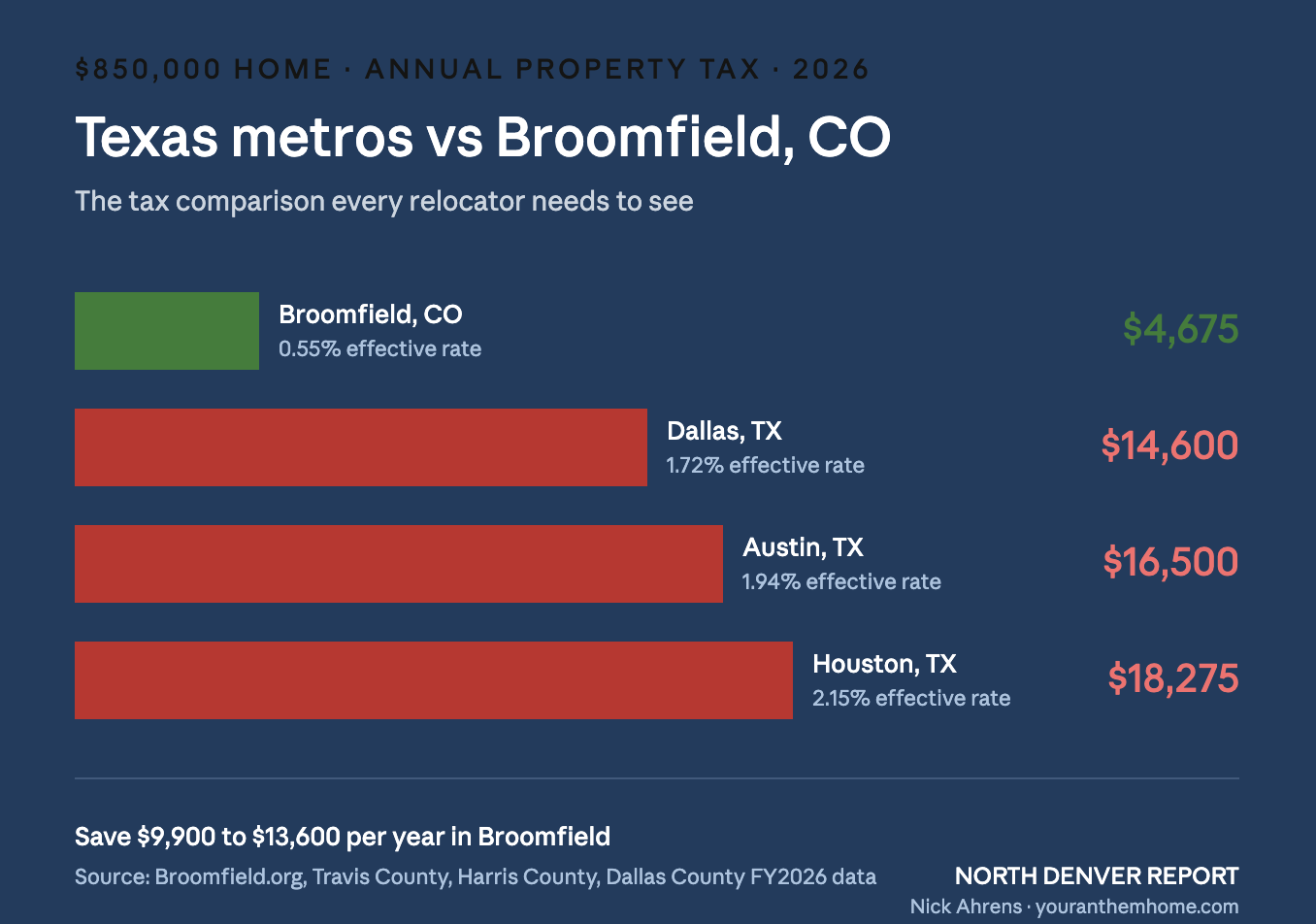
Sources: City and County of Broomfield Property Tax 101 (2026), Dallas County Commissioners Court FY2026 adopted rate, Travis County FY 2026 Taxpayer Impact Statement, Harris County FY 2025-26 tax rate adoption, U.S. Census Bureau American Community Survey 2019-2023 5-Year Estimates.
What the Savings Actually Buy You in Broomfield
The difference between paying $18,000 per year in Houston property tax and $4,675 in Broomfield is not a rounding error. It is $13,325 per year, or $1,110 per month, that stays in your pocket. That is an extra mortgage payment's worth of buying power. Most of my Texas clients reinvest that in either a larger home (the $850K Broomfield home becomes a $1.1M Broomfield home with the same total monthly cost as their old $750K Austin home) or they bank it toward retirement. Either way, the property tax arbitrage is the single biggest financial reason Texas tech and energy workers have been moving north since 2022.
What This Looks Like in Anthem, Anthem Highlands, and Baseline
In the three Broomfield master-planned communities I specialize in, an $850K home is the heart of the market. Anthem in Broomfield gives you a move-in-ready home from builders like Toll Brothers and Taylor Morrison, with resort-style amenities and the Pinery golf course. Anthem Highlands offers a lower price point and a family-heavy demographic. Baseline, the newest of the three, is a walkable urbanist community anchored by a 110-acre park and the Baseline Center retail district. All three communities sit inside Broomfield County's combined tax district at roughly the same effective rate. Browse current listings in all three at youranthemhome.com/home-search.
Ready to Run Your Own Numbers?
Every Texas-to-Colorado relocation I handle starts with this exact math, customized to your income, home price, and target community. Send me your Austin or Dallas or Houston address and a target price range, and I'll build a side-by-side cost sheet for your specific move, including HOA, metro district, insurance, and total carrying cost. No guesswork, just numbers.
Work With Nick Ahrens, Broomfield Real Estate Expert
Top 40 Under 40, Hall of Fame, 350+ closings, $300M+ career volume. Specializing in Anthem, Anthem Highlands, and Baseline for Texas and California relocators.
📱 Text Nick: 949-230-3625
📧 Email Nick:NickAhrensRealestate@gmail.com
🏠 Browse Broomfield homes:youranthemhome.com/home-search
⭐ Check my reviews:zillow.com/profile/NickAhrensRealEstate
Frequently Asked Questions
How much is property tax on an $850,000 home in Broomfield, Colorado?
An $850,000 home in Broomfield generates roughly $4,675 per year in property tax using the combined mill levy of approximately 122.872 mills and Colorado's 2025 residential assessment rate of 6.25% for non-school levies and 7.05% for school levies. That is about 0.55% effective rate, significantly below the national average of 1.02%.
Why are Texas property taxes so much higher than Colorado's?
Texas has no state income tax, so counties, cities, school districts, and special districts rely heavily on property tax to fund schools, police, and infrastructure. Effective rates in major Texas metros run 1.6% to 2.3%. Colorado charges a 4.4% state income tax and spreads the burden, so effective property tax rates in Broomfield sit near 0.55%.
Does Colorado's 4.4% income tax cancel out the property tax savings?
For most Texas relocators earning under $300,000, no. On a household income of $250,000, Colorado state income tax runs about $11,000 per year. The property tax savings on an $850,000 home between Houston and Broomfield is roughly $13,000 per year. Higher-value homes and middle incomes widen the Broomfield advantage further.
Which Texas metro has the lowest property tax on an $850K home?
Of Dallas, Austin, and Houston, Dallas County has the lowest effective rate at roughly 1.68% to 1.74%, producing an $850K tax bill of about $14,600. Austin and Houston both push past 1.9% when combined city, school, county, and MUD levies are included, landing closer to $16,500 to $18,700 annually. Collin County suburbs like Plano and Frisco push even higher, to $19,550 on the same home.
Does Colorado have a homestead exemption like Texas?
Colorado offers a senior homestead exemption of 50% of the first $200,000 of actual value for homeowners 65 and older who have lived in the home 10 years. There is no general homestead exemption for all homeowners like the $140,000 Texas school district exemption, but Colorado's base effective rate is so much lower that the net result still favors Broomfield by a wide margin.